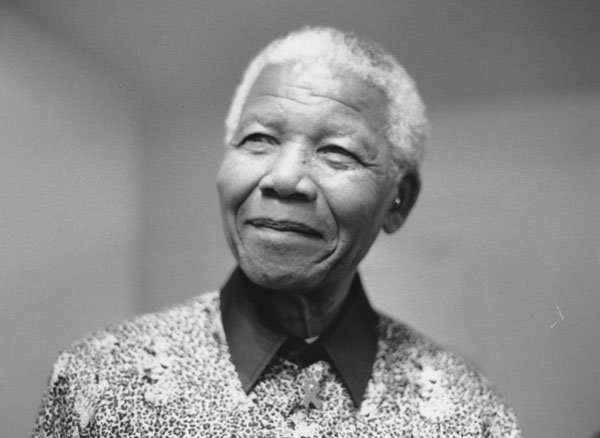
Nelson Mandela’s death has prompted abundant reflections on his life and his life’s work.
He was a symbol of peace, justice, equality, and democracy, and at the same time he was an enemy of racism, oppression, systemic injustice, and exploitation.
But Mandela was also a complex person — he was both a political radical and the winner of the Nobel Peace Prize — with a simple focus: to break the yoke of oppression and inequality. This was the purpose to which Mandela devoted his life.
Shortly after Mandela was arrested with four counts of sabotage and conspiracy to violently overthrow the government, he addressed the court with what is now one of his most famous speeches. In that speech he said:
“During my lifetime, I have dedicated myself to this struggle of the African people. I have fought against white domination, and I have fought against black domination. I have cherished the ideal of a democratic and free society in which all persons live together in harmony and with equal opportunity. It is an ideal which I hope to live for and to achieve. But if needs be, it is an ideal for which I am prepared to die.”
Mandela did not die, but served 27 years incarcerated, 18 of which were on Robben Island as a political prisoner.
But he was more than just a prisoner, he was a symbol. And he knew it.
In his autobiography, Long Walk to Freedom, Mandela said,
“In a way I had never quite comprehended before, I realized the role I could play in court and the possibilities before me as a defendant. I was the symbol of justice in the court of the oppressor, the representative of the great ideals of freedom, fairness and democracy in a society that dishonoured those virtues. I realized then and there that I could carry on the fight even in the fortress of the enemy.”
The fortress of the enemy for many of us is not a colonial, imperial, segregate system like the one Mandela fought against, but rather a subtle, almost innocuous system that, while good in many ways, still leaves many oppressed and exploited in its wake.
What is most interesting, or perhaps most distressing, is that although much has changed since Mandela’s incarceration in 1962, much has remained the same.
Consider this striking passage in Alan Paton’s famous South African novel, Cry, The Beloved Country, published in 1948, only a few months before the political establishment of apartheid:
“It is not permissible to mine any gold, or manufacture any product, or cultivate any land, if such mining and manufacture and cultivation depend for their success on a policy of keeping labour poor. It is not permissible to add to one’s possessions if these things can only be done at the cost of other men. Such development has only one true name, and that is exploitation. It might have been permissible in the early days of our country, before we became aware of its cost, in the disintegration of native community life, in the deterioration of native family life, in poverty, slums and crime. But now that the cost is known, it is no longer permissible.”
Having the tendency to add to one’s possession at the cost of other people, at the cost of community or family life, could be said of Canada, the U.S., Britain, or really any other developed nation with a soft-spot for unbridled economic growth.
Unbridled economic growth has long been the seedbed for slavery and oppression and exploitation. But this, as Paton says, is no longer permissible. The beloved, our beloved, should not be made to cry. They should not be treated as unequal, no matter their race, appearance, income, family, or gender.
We are called, in our humanity, to break the yoke of oppression and inequality. Mandela devoted his life to this, and maybe we should too.