
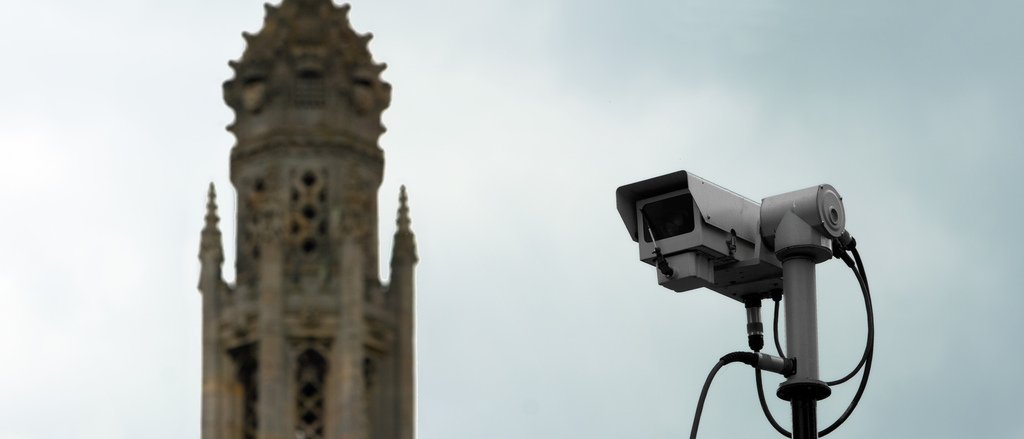
Google knows where we live, Facebook knows whom we like, Amazon knows what we buy, and governments know pretty much everything else.
It’s a worrisome prospect to think that we might be living in a world that closely resembles George Orwell’s 1984, but it is even more worrisome to think that people are apathetic about such a world.
I hear about whistleblowers like Edward Snowden, learn about the power of technology, read about the ulterior motives of government activity, and I am convinced that privacy is the biggest moral and ethical issue that we face in the 21st century.
The relevance of privacy should be immediately apparent when one considers the reach that social media, tech companies, and governments have in our private lives. But most of us are apathetic about the ways in which technology allows corporations and governments to retrieve personal information that we would not otherwise divulge.
We’ve all felt annoyed by Facebook’s loose and (intentionally?) confusing privacy policies, but I am also sure that most of us — evidenced by the fact that we continue to use things like Facebook — have accepted our loss of privacy. This is the way the world is. We either accept it or reject it, the latter obviously being much less enticing than the former. As former Sun Microsystems’ CEO Scott McNealy infamously declared in 1999, “You have zero privacy anyway. Get over it.” Sometimes it seems we have indeed spent the last 14 years getting over it.
Is privacy important?
But is this a good thing? Is it okay for us to be apathetic or accepting about our loss of privacy? Is privacy really that important? After all, isn’t it true that if you have nothing to hide you have nothing to fear?
The answer is yes and no. If the violation of privacy is done in service of the greater good, if it leads to increased protection for individuals at risk, then yes, violation of privacy can easily be argued to be a good thing. This is why I have little problem (besides the inconvenience) with things like increased airport security or boarder controls. But, if the violation of privacy is done in service of greater control, not the greater good, then no, the violation of privacy cannot be seen as a good thing.
Privacy is a debate about who gets to control information. Information is a powerful thing; it is the root of our modern pursuit of knowledge and authority. In our modern democratic age, whoever controls information controls power. The problem of course is that those in power do not always use information to serve the greater good. This is why privacy is important and why individuals should be given a certain amount of freedom from coercion, manipulation, prejudice, exploitation, or unfair judgment. Privacy, in essence, protects those who cannot protect themselves.
The right to privacy
Samuel Warren and Louis Brandeis, the two Boston area lawyers who gave us our modern language concerning privacy in their 1890 paper called “The Right to Privacy,” described privacy as “the right to be left alone.” Much can be said in opposition to our desire to be left alone but I believe that the modern defense for individual autonomy is a necessary evil.
Theologically speaking, individual autonomy is not true because humans are never fully autonomous from God (cf. Job 34:21-22 or Romans 8:37-39) and our desire to be autonomous was the reason that privacy is even an issue in the first place (see the fall of Adam and Eve in Genesis 3), but politically speaking, privacy is necessary because we do not live in a world where we can trust that our personal information will be used for the greater good. When we speak about privacy we must always ask, for whose greater good is our personal information used for? Is it the greater good of national security, or the greater good of profit for private companies? When does the desire for security or profit justify the loss of individual freedom?
Wrestling with the issue
The answers to these questions are both complicated and difficult, but I hope they are answers that Christians are wrestling with. To not wrestle with these questions is to apathetically accept that we have already lost our right to privacy, as Scott McNealy so poignantly declared.
In the aftermath of Edward Snowden’s recent run-in with the N.S.A. (National Security Agency) about his leaking of confidential U.S. documents, I tried to look for a substantive Christian perspective on the issue of privacy and surveillance. I found very little. My hope is that Christians are working diligently behind the scenes to compose a well-informed theology of privacy (à la Eric Stoddard), but my fear is that Christians are apathetic about the whole thing. This would be a shame, of course, because if it were true, we would be losing much more than just our privacy.
Flickr photo by Erich Kesse