
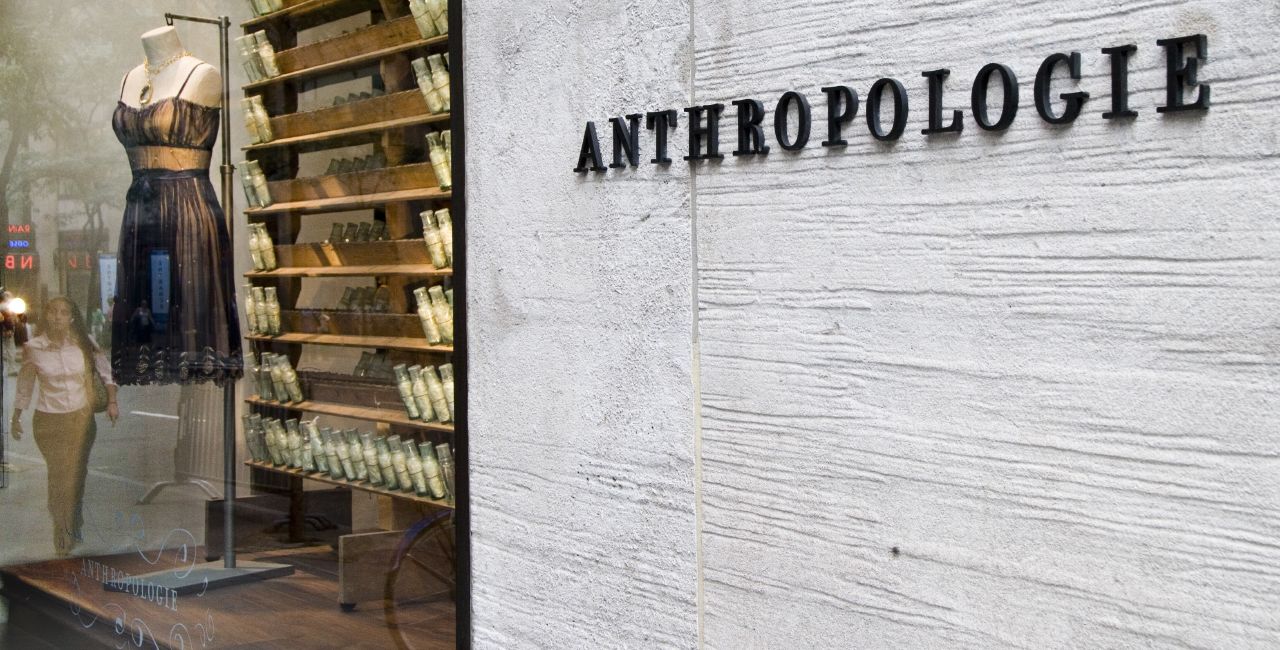
 Every month my roommates and I receive in our mail a catalogue from the company Anthropologie. This is a bit strange considering that I live with a bunch of guys who care very little about women’s fashion trends, but at some point in our community house’s long history someone must have purchased something from one of their 175 stores located throughout North America and the UK.
Over the last several months, as the Anthropologie catalogues stack up and litter our den, I’ve noticed that many of our guests pick them up off our coffee table with great enthusiasm. These catalogues, I will admit, certainly boast gorgeous women wearing flattering clothes, but Anthropologie is not just any ordinary woman’s clothing store. With its exquisite attention to detail, Anthropologie behaves more like an artist at a gallery opening than a car salesman at a dealership. Their unique apparel and home décor appeals to the female artist-adventurer-interior decorator and promises to make life more exciting. As their UK website makes clear:
Anthropologie offers a one-of-a-kind and compelling shopping experience that makes women feel beautiful, hopeful and connected. We invite you into our world — whether it’s our store, website or catalogue – with the hope you take a deep breath and explore until your heart’s content.
While some may want to accuse Anthropologie of a shallow and naïve consumerism, I would argue that’s not the lesson to be gleaned here. Instead, we ought to appreciate how Anthropologie has figured out exactly what kinds of creatures we are. As the philosopher James K.A. Smith argues in Desiring the Kingdom, “the way we inhabit the world is not primarily as thinkers, or even believers, but as more affective, embodied creatures who make our way in the world more by feeling our way around it.” Put differently, we are what we love.
With this recognition in mind, it seems to me that Anthropologie has actually stumbled upon a great anthropological truth. Whether it’s the carefree brunette loading her coated canvas weekender with kale from the local farmer’s market (June 2012, p. 51) or the vivacious red-head standing next to a scruffy grey dog in the Scottish Highlands while wearing a patchwork variations sweater dress and textile sturdy wedge boots (September 2012, p. 15), Anthropologie dreams up creative, picturesque storylines and asks us to play along.
So the question becomes this: Should we play along? How should we respond to our own desires to live as consumers? A first step, it seems, is to be more aware of how media and marketing affect us. The storylines like those mentioned above form what Smith describes as “tiny narratives packed into images that appeal to our faculties of desire and inscribe themselves into our imagination.” As a result, companies like Anthropologie actually maintain “a better, more creational, more incarnational, more holistic anthropology than much of the (evangelical) church.” A second point related to all this is that Christians ought to take the aesthetic dimension of their faith more seriously. Certainly, in our consumerist age, the clothes we wear shouldn’t consume our innermost thoughts, but that doesn’t mean we should completely ignore art or fashion trends either. Theology professor John Stackhouse elaborates:
The appearance of Christian churches, Christian homes, and Christian bodies communicates our values. We are known by our art. If we keep our churches, homes, and bodies bereft of art, or bereft of good art, we are saying something about what we hold to be Kingdom values — and what we are saying is heretical, namely, that God doesn’t care about the aesthetic.
What this means for religious believers is that the world Anthropologie promises — a world of art, fashion, and adventure — should not be stamped out by ideas and doctrines of faith. Rather, any good art, fabric, or piece of clothing should be seen as a signpost of God’s ultimate goodness. For Christians and the church, this not only requires much wisdom in a world burdened by consumerism, but it also demands that we have a theology that responds adequately to our true anthropology.
Flickr photo (cc) by NYCArthur