
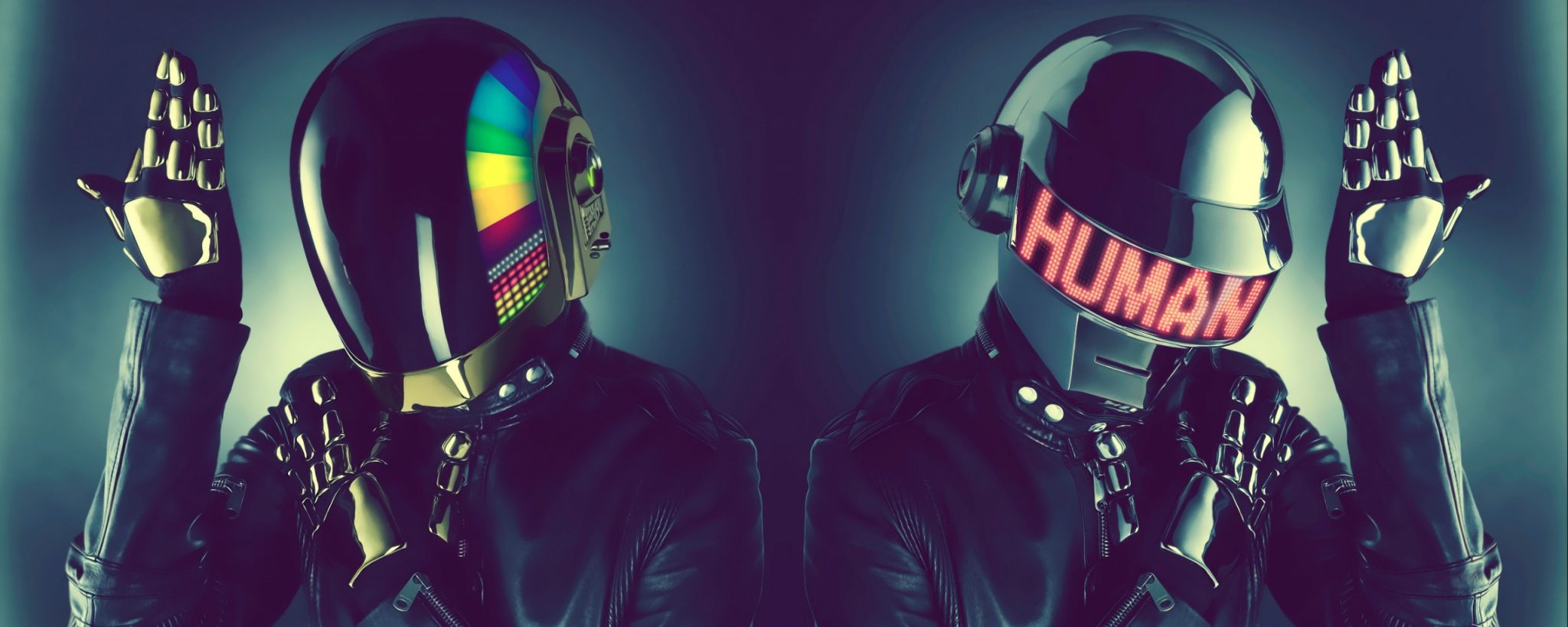
After eight years of studio album hibernation, French musicians Thomas Bangalter and Guy-Manuel de Homem-Christo of the famed robotic duo Daft Punk have released their greatly anticipated Random Access Memories (R.A.M). Already touted as a major success — their first single, “Get Lucky,” sits atop the charts in the U.K. and several other countries — R.A.M. showcases the best parts of a band that has both mystified and enthralled its listeners for over a decade. If you’re not sure exactly what to think about this mysterious robot-clad electronic group, I don’t blame you, but let me give you three random reasons why I think you should love Daft Punk:
1.Their anonymity.
Maybe the world’s most famous robots, Bangalter and de Homem-Christo sport their exotic android costumes for all their live performances and non-animated music videos so that few people actually know what they look like. Granted, we know their real names and can Google them like anyone else, but chances are you’ve never actually seen them or could pick them out of a lineup. While this frustrates the paparazzi and confuses fans, it also shows that Daft Punk cares more about their music than their individual fame. Asked about their decision to shroud themselves in mystery, Bangalter said in a 1997 interview, “We don’t believe in the star system. We want the focus to be on the music. If we have to create an image, it must be an artificial image. That combination hides our physicality and shows our view of the star system.” Of course, it would be ridiculous, perhaps even pretentious, for musicians everywhere to start donning robot masks to try to avoid fame, but in an age that worships pop idols, Daft Punk subtly and humorously subverts our star-studded celebrity culture.
2. Their critical engagement with technology.
In their twenty years of music making, Daft Punk must own up to the fact that they are largely responsible for the onslaught of synthesizers, drum machines, and auto-tuning that characterizes much of today’s music. This is not all bad of course, but for traditionalists who prize live performances and the skill required to make something great from scratch, Daft Punk may seem little more than a glorified pair of DJs. Still, there is something to admire in Daft Punk’s experimentalism. Back in the early ‘90s when they first started using artificial means to arrange and produce their music, they helped people realize they could make music from home without expensive recording equipment. But now, with everyone doing the work from laptops, Daft Punk has again stretched their horizons and done something new. In R.A.M., they have taken over a year to assemble an impressive list of collaborators—including Animal Collective’s Panda Bear and Julian Casablancas of The Strokes—to show that great music requires a combination of patience, skill, and talent. While not shunning technology completely, R.A.M. uses it sparingly and opts instead for the more difficult, expensive, time-consuming, but ultimately enjoyable process of teaming up with famous musicians from the past and present to record their live work. There’s a serious lesson in this, and it’s something Daft Punk wants to communicate: As Bangalter said in his interview with National Public Radio, “The fun is making the actual music and not totally relying or relying heavily or primarily on technology.”
3.Their humanity.
Finally, despite pretending to be robots, one of the recurring themes in Daft Punk’s music is that there is something unique, wonderful, and inexplicable about being human. In fact, if we were to get more philosophical, we could ask whether it’s even possible for a robot or artificial intelligence to create music. Without directly answering that question, Daft Punk seems to hint that there is something uniquely human about the desire to make and listen to music. Perhaps that is why many of their music videos feature robots yearning to experience human emotions (e.g. watch “Get Lucky”). Their third album, Human After All, also explores this concept in the face of our highly technological world, and in their song “Technologic,” they poke fun at our obsession with technology. Now with their fourth album, one hears a definite desire to break out of a mechanized, impersonal view of humanity and tap into whatever makes us truly human. Ironically, then, Daft Punk’s work suggests that we are neither robots nor cogs in a machine but human beings with the creative capacity to make music and dance. This perception—that we are creative, embodied persons living in an apparently impersonal, technological world—produces a dynamic tension in Daft Punk’s work.
Overall, there are many things to love about Daft Punk and their new album. Besides the ridiculously contagious dance track, “Lose Yourself to Dance,” Christians will be curious about some of the album’s lyrics such as, “There are so many things I don’t understand” (track 2, “Within”), “I need something more” (track 5, “Touch”), and “Love’s a holy mission … a journey of the soul” (track 7, “Beyond”). This is not to suggest that these androids are regular churchgoers, though. After all, they are robots. But, as this album suggests, these robots want to discover the source of their creativity, and ultimately – like the rest of us – they want to discover what it means to be truly human.