Writer-director Brad Wise talks about what’s important, and what’s not, for a Christian who makes movies.
It’s not like I was a kid dreaming of making movies one day. I never really set out to do any of this stuff. It just kind of happened.
Brad Wise has the shell-shocked look of a guy who just found out his wife is having triplets. His voice is quiet, maybe slightly preoccupied. I expected more fist-pumping, more chest-pounding, more promotional rhetoric. For a guy who brought together a pastor, a 1960s TV icon, and the poster girl for pop Christianity to make an indie film that defies the boundaries of most any category you could shoehorn it into, Brad doesn’t come off like the one-man hype machine I expected.
Back in 2008, Brad was working at a Vineyard church in Cincinnati, Ohio, not far from where he grew up. He started hanging out with a group within the church who had creative tendencies. The ideas they tossed around snowballed into a few good stories, which became short videos and sketches for use on Sunday mornings. In 2008, they put together their first “big” production–a 20-minute Christmas-themed mashup presentation of live action and film.

Brad says that was the first time they felt like more than just a group of friends messing around with video equipment. All of a sudden, they were a crew, and their project was a production.
It was also the first time, for many of them, that they felt the stirring to life of certain gifts that they’d never put to work. The feeling, Brad says, was addictive.
All that stuff that we never knew what it would be useful for? We got to do something with it, and felt like, “Whoa, we should do this again.”
That same year, Brad and his friend Joe Boyd, a teaching pastor at a church in Las Vegas, began writing a story that drew on their own search for happiness. The script that resulted (after several iterations and thrown-away drafts) is “A Strange Brand of Happy,” which Brad is hesitant to describe as a Christian movie.
It’s kind of a quirky existential comedy with a couple love triangles thrown in to keep it interesting. But that doesn’t fit well on a poster.
I like to pride myself on keeping a conscientiously open mind; that doesn’t stop me from marshaling a host of pre-fab judgments when I read the words “faith-friendly” in the film’s press release. Even as the opening credits roll, I’m listening for the telltale qualities of a CCM artist on the soundtrack, and speculating on how closely the acting will resemble what I’ve seen in school chapel presentations. Above all, I’m wondering if there’s going to be any kissing in this movie, not least because it stars the darling of the True Love Waits movement.

Given Brad’s non-hype approach to our conversation, I feel like I should dial down my aggressive cynicism about the “faith-friendly” genre he’s entering. To my surprise, he shares it–“I’m with you when it comes to being cynical about Christian art.” What he’s seen in that market, he hasn’t found terribly compelling, especially when it comes to film. As an example, he brings up the recent adaptation of “Blue Like Jazz.” But then he lets it fall, without any actual criticism of it–“You could argue whether what they did worked or not.”
The thing is, Brad says, he and his friends weren’t trying to make a Christian movie. They weren’t even really trying to break into the movie business. Their objective, then and now, is almost disingenuously simple.
I just try to write a story that me and my friends would like.
Even without taking a target audience in to account, they had their hands full. They were just a group of guys who made movies in their spare time, suddenly taking on a feature film with no more than a story they enjoyed, and the expertise of an instructional DVD titled “How to Make an Indie Film.”
Brad says that on more than one occasion, he wondered if he’d made a huge mistake.
“Like, the third day,” he chuckles. “It was 1am, and we weren’t going to get the shots we needed.” He laughs again. “Day Three! And I’m having this real panic moment, thinking of all the individual people who gave us money, thinking ‘I’m going to waste all their money.'”
What got him through it, he says, is a line he heard from a pastor he knew long ago.
“God can’t steer a parked car.” It’s kind of cheesy. You have to to have some sort of motion. As long as we’re in some sort of movement, He’ll help us out.
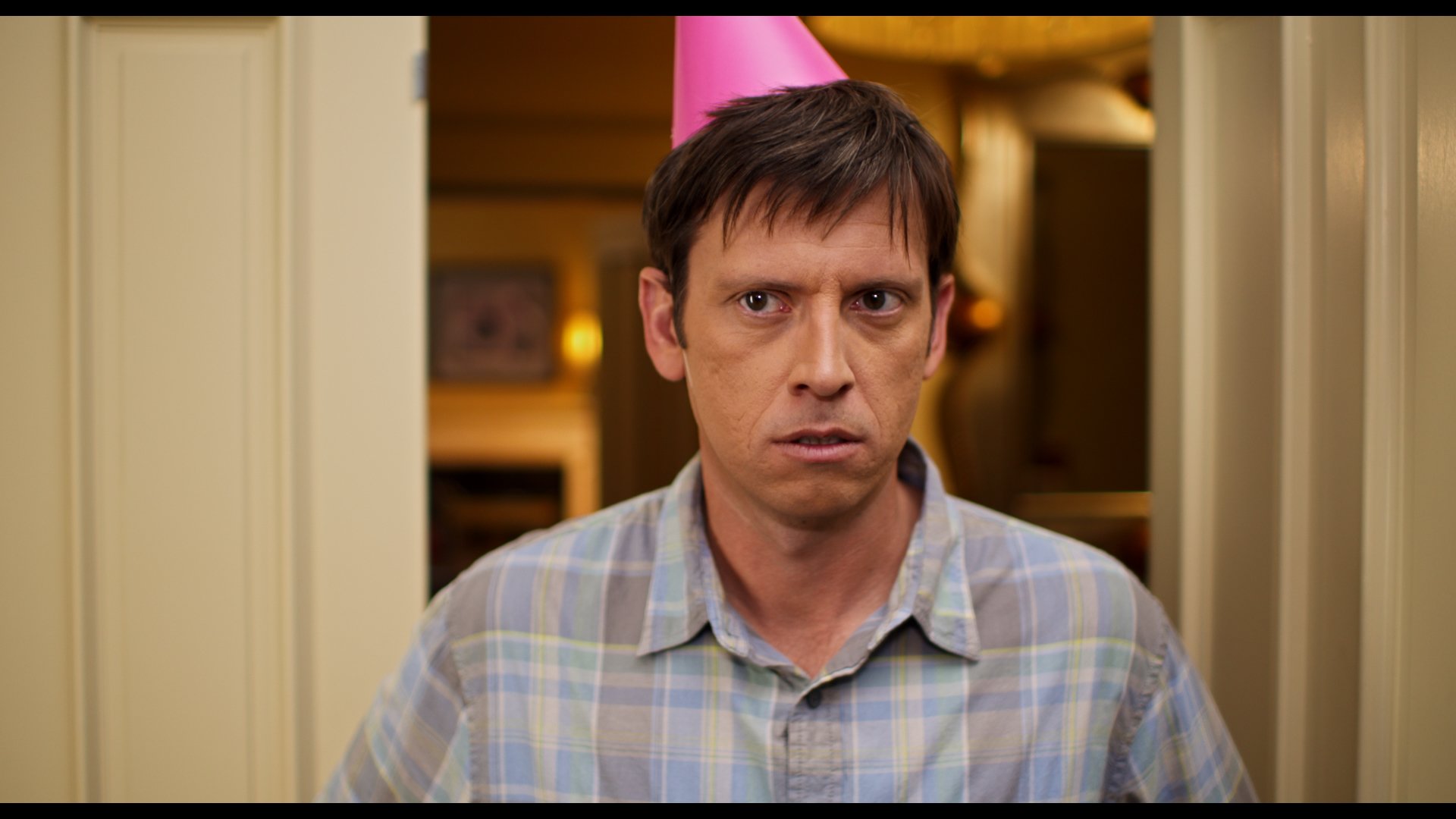
“A Strange Brand of Happy” centers around David, a comfortably aimless bachelor who sours on the concept of happiness after getting fired by his douchey boss. His best bro cons him into a meeting with life coach/yoga teacher Joyce, who serves as the films spiritual sun. David falls into her orbit, and…well, you know…

Or maybe you don’t.
In some ways, “A Strange Brand of Happy” plays by the rules of its inevitable category. In other ways, it doesn’t at all.
As a result, it’s drawn both praise and skepticism from many potential distributors.
We made a thing that some Christian faith-based distributors are like, “This isn’t Christian enough.”
By those standards, Brad says, they get a PG-13 rating. As a film, most distributors like it. As a Christian film, they don’t know how to deal with its lack of explicit gospel message or its frank portrayal of how regular guys think (and talk) about girls. (Especially when that girl is the unofficial spokesmodel for Christian romance.)
What I found most surprising, and appealing, about the movie was its attitude. The writing is self-aware and sardonic; the acting relies on the personalities of the actors, some of whom really deliver. For a movie made by a bunch of church guys, it feels altogether un-preachy.
While some of Brad’s Christian friends demand why he wasn’t more explicit about the gospel, his nonbeliever friends insist that he break out of the faith thing and make “real” movies.
“There’s that weird thing in Christian art where you get accused of wanting to preach at people,” he says. “You can’t control how people are going to receive it. You have to find your meaning and purpose in the process. I try to stay focused on what matters–making stuff with your friends. Otherwise, you’re going to ride that roller coaster of people’s opinions.”

The film doesn’t come out until September, but even the YouTube trailer has garnered a string of highly opinionated rants. “That actually felt good,” Brad smiles. “We have someone who hates us! We’re venturing out of our camp into the real world. but it’s going to be really hard come the week after Sept. 13, when people are writing about what they hate about the film.”
This surprises me–I ask him what they’re going to hate.
“Anything. everything. They’re going to hate it for the thing the other guy loves.”
Brad shrugs.
“That’s art.”
—
A Strange Brand of Happy opens in select theatres on September 13, 2013.
Learn more by visiting the film’s website, or find it on Twitter.