
Why read in this age of Facebook, viral videos and top 10 lists?
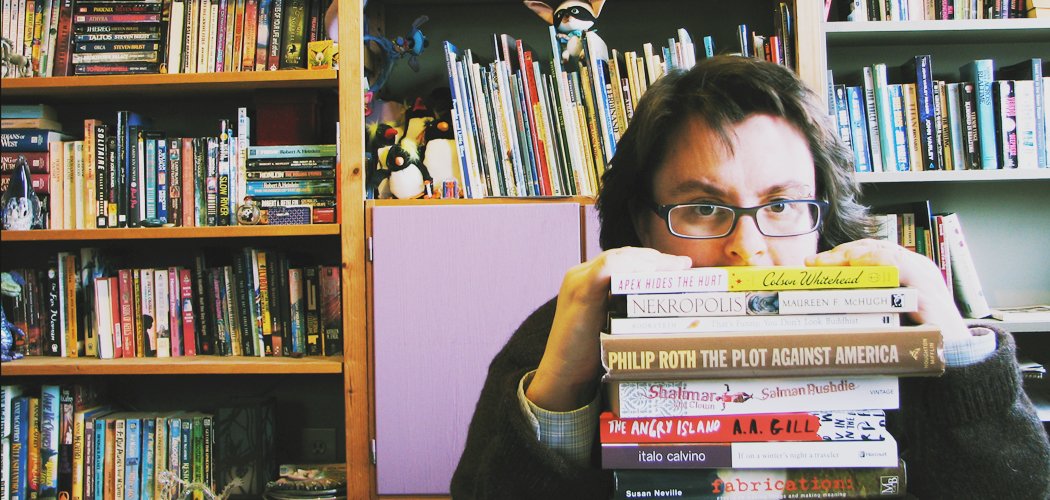
There they are. All lined up on my shelf, huddled like a clique in the cafeteria. The rest lay in a pile on the floor, like someone yelled “dog-pile!” and then unloaded on them with an Uzi.
They’re my books. At least a hundred and fifty, scavenged from Powell’s in Portland, student bookstores, and Amazon. Books of all kinds: philosophy, memoir, biography, self-help. Some of them get read occasionally, but very few are ever finished. Why?
Some would blame YouTube or cell phones, busyness or Facebook.
I blame the Greeks. I blame them because they remind me of a time when our civilization got along perfectly well without books.
If you were to trace the roots of Western civilization down to a single book, it wouldn’t be the Bible (although that would come a close second). It would be a book called The Republic, featuring a Greek named Socrates.
The strange thing is that Socrates didn’t write it. Plato did. Socrates was the greatest mind of his time, and he didn’t write anything. Neither, for that matter, did Jesus. Yet these two men shaped our civilization more than any others. How did they do it? In this day and age, the best way to change the world is, apparently, through viral videos (see Kony 2012). Back in Socrates’ day, the best way was through viral ideas.
You’re probably educated on the ideas of Jesus that went “viral,” so to speak. But what about Socrates?
His “viral” idea was that truth was more important than anything else, and that the best way to find truth was through conversation. Instead of giving long-winded speeches like other Greeks, Socrates became very good at asking questions. “What are the natures of wisdom, justice, and love?” These are the sorts of issues he discussed.
Plato, a student of Socrates, decided these discussions were worth writing down. Hence, the most important book in our civilization’s history (according to most professors) is a book about the things that are most worth talking about, and how to talk about them.
This, I believe, is the reason why we don’t read as much, or as well, as we should. We have lost the art of what’s behind the books. The art of conversation.
But how can you have a conversation with a book?
When I sit down with a book, I often feel oppressed by the fact that it feels like a one-way street. I don’t get to push back, ask questions, or demand clarification. I just sit there as the author tells me how it is. If I don’t like it, I smugly put him back on the shelf. I don’t usually read my books in the context of a greater conversation.
I do, however enjoy reading articles recommended on Facebook or Reddit. There, I can have an immediate conversation: I can get a sense of what other people think before I read the article, then I can read comments from friends and strangers underneath. Occasionally I can even dialogue with the author.
The Internet has led me to expect easy, quick access to relevant information. I expect the author to get to the point: to share his best ideas in as few words as possible, preferably in bulleted points or a top 10 list to keep my rapt attention. That, or a link to his TED talk video. I expect to engage with his thoughts, and others reading the same article, right then and there. I’ve become used to reading in a (virtual) community.
In my weaker moments, I convince myself that this process is more worthwhile than reading, because it allows me access to the latest information, and to gauge the importance of new information by its popularity. These days, information flows so rapidly, it’s hard to know what information is useful and what isn’t. It’s like trying to drink from a fire hydrant. I end up soaked, but still thirsty.
The problem with this new method of deciphering information is that it doesn’t use rationality or wisdom to filter the good from the bad, but mere popularity, which can be manipulated depending on how many kittens/explosions/babies are involved.
Greece had a central square in Athens where the men (and perhaps a few women dressed like men a la Life of Brian) would gather. Different respected men would get on a platform one at a time and deliver speeches on how society should be run in glossy rhetoric. I wonder if they made top 10 lists, like, I don’t know, “Top ten reasons we should get an aqueduct.”
“One, It brings us water! Two, they look cool! Three, it doubles as a waterslide!”
Then other men would reply with clever retorts, “You can’t use a wooden aqueduct as a waterslide! What about splinters?” The job of each speech-giver was to win over the support of the group, as a group. He didn’t meet with each person individually. He didn’t take his time winding his argument this way and that, asking for hours upon hours of attention. He had to make his time count, and win the hearts and minds of the group, who would gauge the reactions of others when making up their minds.
The difference between my Facebook conversations, and those of the Greeks, is the end goal. The Greeks were concerned about how to run Greece. They took this responsibility seriously. They talked about it, a lot. The number of times I’ve talked about “how we should run society” on Facebook? I could count them on my third hand.
By the time books became more commonplace, their role was understood as a supplement to a great conversation that was already ongoing in society. It was a conversation that began with how to best operate things. This naturally drifted into more philosophical and religious discussions about the nature of reality, humanity, God and so on. This conversation continued for generations in social squares, but also through text. The voices of figures like Socrates and Jesus were recorded so that future generations might benefit from their wisdom.
So why did people read? Not only because it was interesting to expose yourself to the thoughts of the wisest in our tradition, but also because it was your responsibility as a citizen. You needed to be aware of what was being said in this great conversation so you could wield this wisdom in your own decisions and conversations, to educate your children, and to keep your government accountable. These books were treasures, to be protected and valued at all costs.
Over the years, other books surfaced which contributed to this conversation, to this treasure trove of wisdom on how society should be run, and how humans ought to live. Certain books have been accepted as contributing to this conversation, but most have been exposed as clutter.
I have to admit, with my constant exposure to my screens, my brain feels as cluttered as my book shelf. After a while, I feel oppressed by it all, by what Neil Postman termed “information glut.”
T.S. Eliot once asked, “Where is the wisdom we have lost in knowledge? Where is the knowledge we have lost in information?”
It is a good question. What use is all this information without wisdom? Does it really help me live a better life? How do I determine what is useful to me, and what isn’t?
Proverbs 4:7 reminds us, “Wisdom is supreme; therefore get wisdom. Though it cost all you have, get understanding.”
Wisdom helps you process information. It helps you make decisions. It helps you deal with life’s biggest puzzles that can’t be solved with Top 10 lists and How-to guides. What happens if wisdom is lost? I like what University of Chicago professor Richard Hutchins has to say, in an essay called The Great Conversation, which helped inform my argument:
“The reiteration of slogans, the distortion of the news, the great storm of propaganda that beats upon the citizen twenty-four hours a day all his life long means either that democracy must fall a prey to the loudest and most persistent propagandists or that the people must save themselves by strengthening their minds . . . Great books alone will not do the trick; for the people must have the information on which to base a judgment as well as the ability to make one.”
Think about that for a second. To save democracy, we must strengthen our minds. Sure, we need information, but we also need the ability to make decisions and for that we need wisdom.
Though our addiction to staying informed may seem like a quicker route to wisdom, it actually hinders our ability to find it. Wisdom does not come quickly. It comes slowly, through experience, but also through training your brain to look for it: to follow complex arguments that may unfold over hundreds of pages. It comes from having conversations with those that are older and wiser, and more often the oldest, wisest voices are found on a shelf rather than a screen.
There are a few books on my shelf that feel like friends. They function in a similar manner. What does it matter to have a hundred friends on Facebook if none are around to help you in real life? Isn’t it better to have deep relationships with 10 friends than superficial Internet friendships with a thousand? Books, like friends, shape us. They support us through hardship by offering sympathy and different perspectives. They remind us what it means to be human, and how to grow in spite of that fact.
I challenge you not simply to read more, but to read better. To read books that have stood the test of time because they offer insight into the mysteries of life, and through exposure to their voices, train us to become better citizens, who do not merely shout (or post) along with the masses, but think for themselves. To read books that are a part of that great conversation that has been ongoing in our civilization since the time of Socrates. To read books that whet our appetite for wisdom . . . and finally, I challenge you to return more often to the one book — and person — that truly offers to give wisdom to those who seek.
Flickr photo (cc) by jspad