
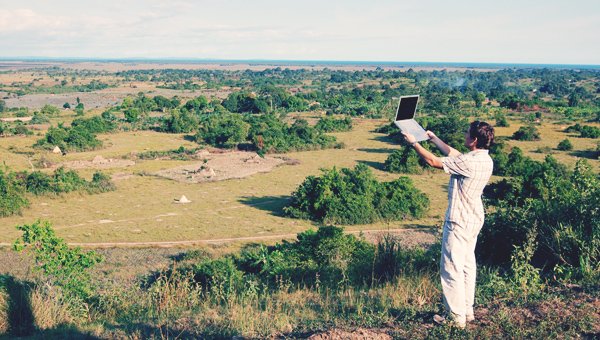
I was never very concerned about where the Internet was until I was unable to find it. I assumed, like many people, that the Internet was an invisible force field of information that had enveloped the world because the Internet is, as they say, world-wide.
However, I have found that in asking the question ‘where is the Internet?’, the interesting part is not in finding out where the Internet actually is, rather it is finding out why I had to move to rural Africa before I knew how to ask the question.
I do not (normally) wish to be ignorant about these things; it just happens that with most things in life, the presence of something is only noticed in its absence.
The Internet, however, is doing itself no favours when people want to ask questions of it’s presence. The Internet is hidden under so much complexity that we have a difficult time framing the right questions to ask. For example, if we ask ‘what is the internet?’ we can find relatively concrete answers. The Internet is a ‘network of networks’ or a ‘set of rules’ through which computers are able to connect or communicate with each other. Or, if you will, the Internet is a tool that serves to aid and facilitate the demands of work and life, even though in the end it actually distracts and interferes more often than not. But if we ask ‘where is the Internet?’ we approach the difficult task of understanding how the Internet actually works and how computers half-way around the world are able to connect to each other.
Part of the reason why it is so difficult to understand how the Internet actually works is because we are unable to visualize or conceptualize the Internet. Unlike a tangible technology like a car, the Internet is not something you can touch or hold. The Internet is merely a connection, a way for two or more computers to communicate with each other, which is why we use mysterious or intangible images like “cyber”-space or clouds to describe where the Internet actually is.
Even though the Internet actually works very similarly to phone networks – some phones are wireless and some phones need to be plugged in, but all phones need to be connected to a service provider – we tend not to see them in the same light. For while a phone call is easily understood to be a relatively straight line from a caller to a recipient, the Internet is a complicated web that connects many callers to many recipients in many locations at the same time. (It also could be that the phone is a stable technology that has existed in more or less the same form for most of our lives, something you cannot say about the Internet.)
So when it comes to the Internet – and to technology in general – what is out of sight is also out of mind. We don’t know how the Internet works or where it is because we simply don’t need to know. Life can proceed as normal for most of us whether or not we actually understand how the Internet works.
This is inevitable to some extent and not at all limited to the Internet because it is impossible for anyone, let alone everyone, to know how all of the technologies or systems we use on a regular basis actually work. We are required to specialize our knowledge to meet the needs of the market and when we have time to our personal interests. The problem is that when it comes to technologies that have the power to change the structure of our lives, like the Internet, most of us are oblivious to the influence it has over our lives. Out of sight, out of mind.
But, I have circled around the question “where is the internet?” many times without giving a proper explanation why I felt I wasn’t able to ask this question before I moved to rural Africa, and the reason is this: I had to be in a place where the Internet was truly out of sight before I was able to bring it to mind.
In a strange way, the complexity of the Internet is less intimidating when you are less dependent on it. You are able to step back and to have a little bit of perspective when you can observe something as an object that you see rather than a technology that you use. In the same way we don’t try to look under the hood of a car while we are driving it, we don’t look for the whereabouts of the Internet when we are surfing it.
In rural Africa, the Internet is not an indispensable part of life. People do not communicate with others, pay their bills, or play games on the Internet. People get along just fine without it. And so the question that I wrestle with as I live in rural Africa is whether it would be a good thing or a bad thing if the local people here were able to answer the question “where is the Internet?” with a confident here.