
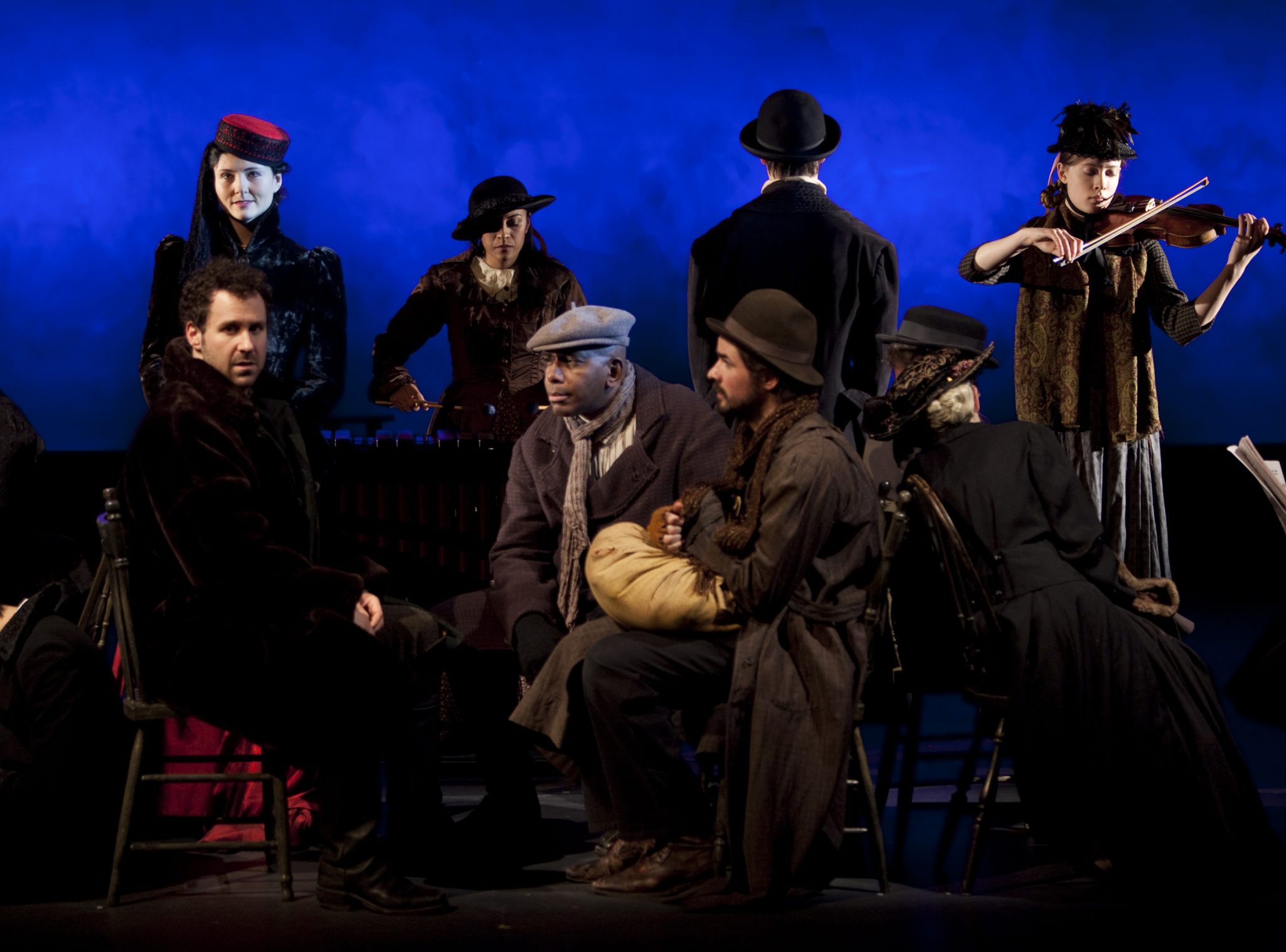
James Fagan Tait’s musical adaption of Fyodor Dostoyesky’s The Idiot whisks you into 19th century Russia on a haunting ride through the dark but comic trials of the innocent and honest ‘idiot,’ whose own goodness pulls him into the struggles of two families, love, a femme fatal and the merciless claws of society.
The story begins with a journey home. The youngest descendant of a noble Russian line, Prince Myshkin (Kevin MacDonald) returns to St. Petersburg after a four-year medical leave in Switzerland to treat his epilepsy. There on this train-ride home Myshkin meets two men: Lebedev (Tom Pickett) and the dark and passionate rogue Rogozhin (Andrew McNee). Rogozhin first laughs at the timid and the supposedly stupid Myshkin, but soon befriends him for those very qualities. He shares with his new friend a portrait of whom he is obsessed- the Nastasya Filippovna Barashkov, a woman whose past and beauty are as haunting as the hair-raising musical number that follows her company. Myshkin is instantly smitten by her eyes, recognizing her painful past. His intuitive ability to read faces speaks true: Nastasya is burdened with a lot of “baggage.” A broken mistress to the older businessman Totsky (Luke Day), she is damaged goods now being gotten rid of. Totsky offers General Yepanchin’s (David Adams) a deal to have his vain assistant Ganya (Craig Erickson) marry Nastasya for 75,000 rubles. This way Totsky can be rid of the responsibility of keeping her while reserving an easy access-way to her bed.
Meanwhile Myshkin seeks out a cousin he’s kept a one-sided correspondence in the previous year who happens to be the aforementioned General Yepanchin’s wife (Patti Allan). Skeptical at first, the two welcome him into the family and Mrs. Yepanchin remarks on how they are both children at heart warmly accepts Myshkin as family. The prince then meets and falls in love with the youngest of Yepanchin’s three daughters, Agayla (Adrienne Wong), but Agayla already has a suitor: Ganya.
However, with Agayla’s father being a lying drunk and 75,000 rubles on hand, it is only too tempting for Ganya to marry Nastasya instead. But when the obsessive Rogozhin demands Nastasya to marry him, offering 100,000 rubles for her to accept him, pride is at stake. But Nastasya is not about to let these men grovel at her feet without manipulating their feelings and having everyone involved in the messy web surrounding the femme fatal played, insulted, and heartbroken. But for poor confused Myshkin, his love for Nastasya is a compassionate pity and he too wishes for her hand in marriage. Though touched by his sincerity Nastasya refuses to marry the prince, fearing that she will only defile his innocence, and runs off with Rogozhin. And that is only the start of it. As time passes, this social commentary will challenge the audience to wonder this: is a sanatorium the only place for a saint in a world obsessed with money, power and sexual conquest?
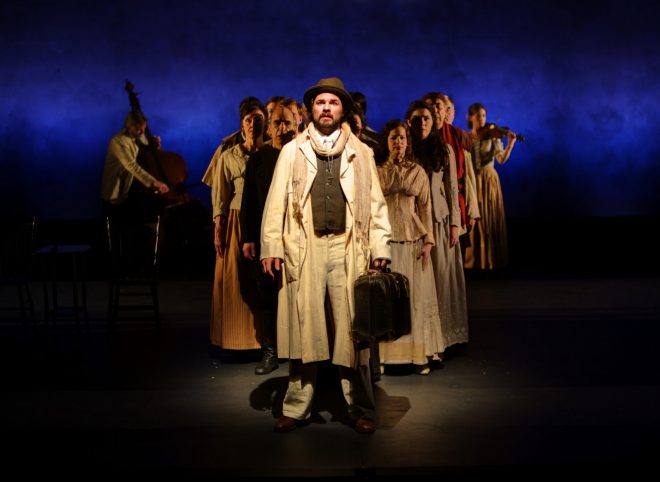
There are many opposites at play throughout. There is the absolute selflessness of Myshkin versus the selfishness of people surrounding him. There are the two patriarchs—one an honorable man and the other a drunken embarrassment; the two women—Nastasya, the conniving object of desire versus the innocent Agayla; the flighty and unsure Ganya and the headstrong obsessed Rogozhin vying for Nastasya’s hand in marriage. But all these characters grow, turning towards the better, the worse or the extreme. While they are in someway affected by the prince’s sincere and honest spirit, Myshkin himself, though seemingly simple, has his own deep struggles but stays unshifting through to the end. Kevin MacDonald delivers a gripping performance, being able to embody Myshkin’s adorable awkwardness and his deep empathy for others, while at the same time showing that Myshkin himself too is conflicted with his own desires.
The stage presence itself reflects that contrasting nature wonderfully. A spacial bare stage is laid out before you—save for a couple of chairs, a few hanging trees and a fireplace—but not once does it ever feel empty. It is the perfect canvas to paint the wide array of settings—three stunning train rides, an elaborate soiree, story time gathering, a busy street, a rickety winding staircase—all with a medium none other than the large 19-person cast itself. The actors create the these scenes with their own physical blocking paired with is colourful soundtrack, from haunting vocals to light-hearted jazzy marimba, beckoning your imagination to fill in the blanks.
As dark and beautiful as the Russian winter, The Idiot will make you laugh but also feel sympathetic. Your heart will fall, but glow with hope. This performance is in investment though, not from your wallet but from the energy spent watching a 210 minute show and soaking in all the grand ideas. You will be well rewarded, walking out of the theatre wishing that everyone, not just the saint-like Myshkin, would live in their hearts rather than their brains.
Commissioned by Neworld Theatre in partnership with Vancouver Moving Theatre, The Idiot is presented by PuSh International Performing Arts Festival and Theatre at UBC and will be shown at the Frederic Wood Theatre until January 29th.