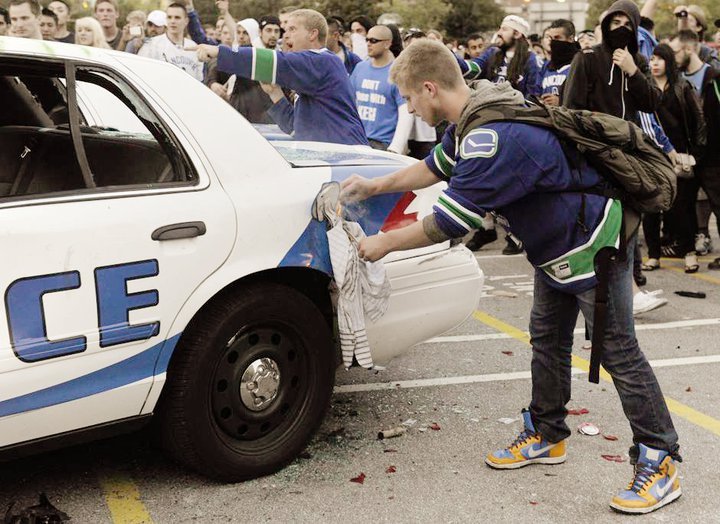
On Wednesday June 15, Vancouver experienced something that it had sadly experienced before: a large-scale riot following the defeat of the home-town hockey team. Many references were made to the 1994 riot which followed the Canucks loss to the New York Rangers.
The 2011 riot showed us the worst possible form of collective effervescence. People ganged up to set cars on fire and vandalize store fronts all the while displaying a complete lack of respect towards police officers and those attempting to defend property. It was harsh, nasty, and relentless.
The next day thousands of pictures surfaced and outed many who had committed acts of crime. A social media firestorm ensued as people berated the rioters for participating in various acts of criminality. The public left racist, shallow, and hateful comments about those involved — Thus taking on the very mob mentality they were so critical of the day before.
This lead to a few public confessions most notoriously a tearful one from, a high school student and talented water polo player from Maple Ridge, B.C. who was captured on camera vandalizing a police cruiser. At the urging of his parents he apologized publicly. As a minor in Canada at the time of his offense he could have been kept anonymous, instead he apologized very publicly.
Another rioter who gained a fair amount of attention was Camille Cacnio who was caught on film with a huge smile on her face following the theft of two pairs of mens size 42 pants from tuxedo & suit specialist Black & Lee. She also issued a public apology in the form of a blog post
Still people were unwilling to forgive. Some felt the apologies insincere and called for the harshest possible punishments. It was as if the public had started its own witch-hunt to track down all offenders and give them their due discipline. The rioters were, after all, the ones who had messed up the city, surely they deserved to suffer the consequences.
There is this six part documentary on the Holocaust called Auschwitz: Inside the Nazi State. In one of the last episodes they interviewed a Jewish man who spent a fair amount of time in concentration camps. He described the train ride back to safety after being liberated and recalled a German criminal on the journey back with them.
The German asked the Jew if he could have a seat as his legs were tired and offered him a couple of cigarettes. The Jew obliged, giving him his seat in exchange for the smokes. When he was finished smoking them, the Jew asked the German to get off his seat but the German refused. The Jew and some of his other Jewish friends then sat on him and suffocated him to death. When the German body became lifeless, they tossed it out of the train without a second thought.
When the interviewer asked the Jewish man if he ever felt sorry for the murder of the German. He replied he wasn’t. Why should he be? The Germans had after all killed over a million of his own people. Even one German life for a million Jewish lives did not seem fair.
This brings us back to the subject of consequences. Do people deserve to pay for their actions, or do we need to look a little deeper and examine the reasons for certain bad decisions? When it comes to punishing criminals, perhaps it would be more effective if we took a more restorative approach to the way we serve justice. If hate and anger only breeds a different form of hate and anger, we will just end up cultivating a culture that will ultimately shame us.