
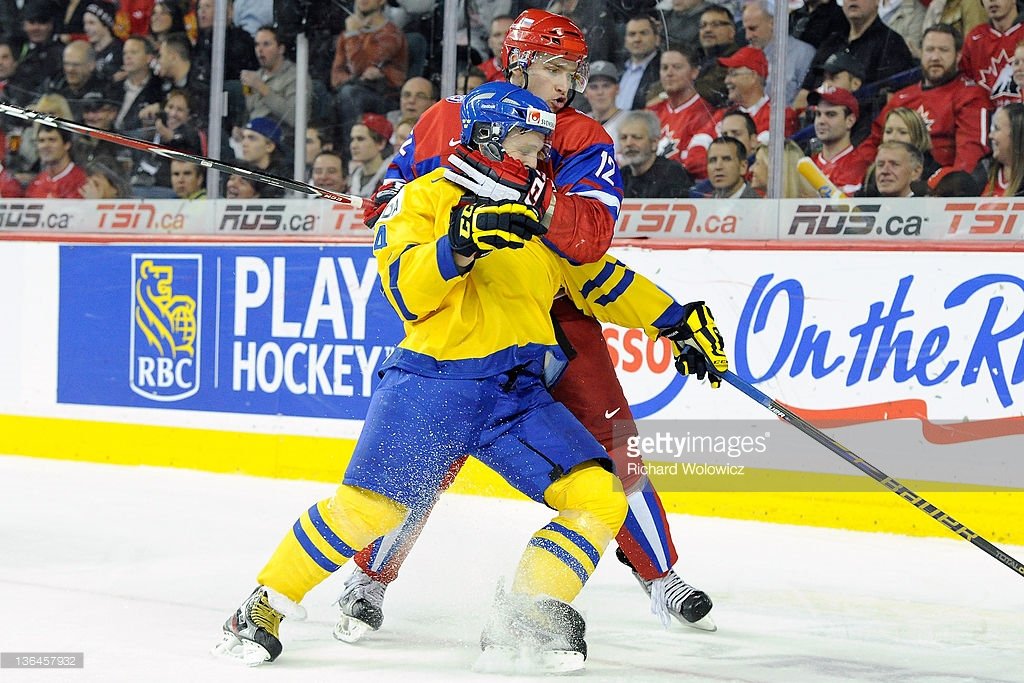
I was reminded of the passion Canadians hold for the World Junior Hockey Championship on my flight from Toronto to Vancouver on January 5th. Although Canada was not playing in this year’s gold medal game, the plane was littered with yelps and muffled cheers in celebration when Sweden scored the overtime winner against Russia to claim their first gold medal since 1981.
Were my fellow Canadians simply cheering over the elation of an overtime goal in a gold-medal game? Hardly. Were my fellow Canadians secretly Swedish? Unlikely. I have little doubt that my fellow Canadians were cheering for Russia to lose even though Canada wasn’t playing.
As a result, one thing became even more evident to me after this year’s World Junior Hockey Championship: Russia remains Canada’s greatest hockey rival. Although the US has made significant efforts in recent years to steal that coveted position, Russia continues to be the country that Canadians most actively cheer against.
The rivalry between Canada and Russia is long and deep. The 1972 Summit series has become such a staple in Canadian folklore that I don’t think anyone would be surprised if they found Paul Henderson’s face on their $10 bill. The first official WHJC was in 1977 and the tournament has served as a seedbed for new generations to be introduced to the rivalry. Canada and Russia/USSR have accounted for 28 of the 35 overall gold medals awarded, with Canada leading the all-time gold medal count at 15, and with Russia/USSR leading the all-time medal count with 29.
In 1987, Canada and Russia took part in the infamous “Punch-up in Piestany” where a bench-clearing brawl in the last game of the tournament led to both teams being disqualified. Arena lights were even turned off in an effort to stop the fighting that lasted 20 minutes. Canada was winning 4–2 at the time of the brawl and if they had won they game they would’ve claimed the gold medal (tournament formats were slightly different back then). With many Canadians still crying foul over the incident believing the brawl to be premeditated on the part of the Soviets, is it any wonder that emotions run high every time these two nations meet?
In recent years, the fights have toned down, but the drama has remained.
In 2009, Canada slipped past Russia in the semifinals after Jordan Eberle scored the tying goal with just 5.4 seconds left in regulation and then the shootout winner in overtime in a thrilling 6-5 game. Canada went on to win gold two nights later. In 2011, Canada held a 3-0 lead over Russia at the second intermission of the gold medal game, but the wheels came off in the third period and Canada gave up 5 unanswered goals in a dramatic collapse that won’t soon be forgotten. In this year’s semifinal game, Canada looked to return the favour by scoring 4 goals in 4 min 57 sec of the third period after falling behind 6-1, but they were unable to score the tying goal and missed out on playing in the gold medal game for the first time in 10 years.
Canada settled for bronze after beating Finland 4-0 in the bronze medal game. The players and coaches should be proud of their bronze medal because winning bronze is an amazing accomplishment, however disappointing it can be at the time.
But as I sat in the plane watching Russia lose the gold medal game to Sweden, I couldn’t help but think that many Canadians were probably just as happy that Russia lost the gold as they were that Canada won the bronze.
Is this a good thing? Probably not. But it sure makes for some compelling hockey.