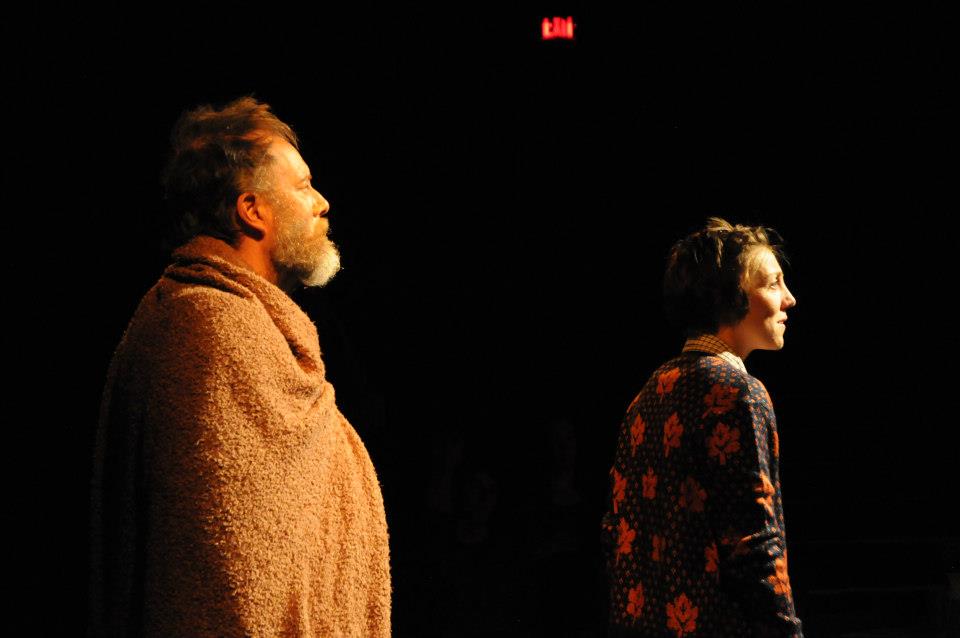
Opening today at Pacific Theatre is The Spitfire Grill, a bluegrass-style musical where a young woman is released from prison and goes to a small mountain town to start again.
With rich themes of forgiveness, redemption, and new beginnings, this play makes a great opening to this faith-based theatre’s season. Produced by a group of collective artists called The Midnight Theatre Collective, the cast and crew of The Spitfire Grill have all done double (or quadruple) duty as performers, musicians, designers, and producers.
In this interview we caught up with Julie McIsaac, playing the lead role of Percy, the young woman seeking a fresh beginning. Also interviewed are actor/musicians Barbara Pollard, Gordon Roberts, and Damon Calderwood. Calderwood not only acts and plays clarinet, but initiated the production.
1) What drew you to The Spitfire Grill?
JM: From the moment I first heard the music, I was hooked . . . The melodies (and harmonies) are simply inspired; there’s no better word for it. It’s the type of music that seems to have always existed out there, somewhere in the ether, and then these wonderful people captured it, shaped it, and shared it with us. It’s just so beautiful and rich — and such a joy to sing. As a woman, I was immediately engaged by the female characters . . . we see such a spectrum, and so much growth, in them all.
DC: I love musicals with a real solid book to them, and Spitfire has a very strong and uplifting story with themes that are dear to me: forgiveness and redemption. I also like musicals in general, and this one has very beautiful and unique music compared to most of the 50+ musicals I’ve done.
2) Why take on the extra responsibility of self-producing/self-engaging? You’ve all had to do a lot more work than just showing up to rehearsal — is it worth it?
JM: Let’s hope so! There are many additional challenges, that’s for sure. But to be working on a piece that you LOVE, that you believe in so very much, and that so accurately captures and reflects all the reasons for which you began doing this work in the first place . . . that’s so very valuable, in my books. When artists come together to create something that they all really want to be a part of . . . there’s a special power in that.
GR: Often shows with important and challenging content which are not subject to the “dumbing down” effects of populist commercial theatre would not get produced unless the actors take it upon themselves. There is also a tremendous pride of accomplishment to work with other professionals in creating a truly brilliant performance.
BP: Do we have a choice? Did not the government cut funding to the Arts by 90 per cent? Have we not lost our Regional theatre? B.C. has a plethora of artists and leaders who do not value them.
DC: I think that the value in telling this story is not in the monetary reward we might, and I stress might, get in the end. It’s the joy of creating (since we all are made in the image of the creator, God) something that has a gripping story with substance and the opportunity to glorify God in some small way through putting on this show. That makes all the extra hours and hours of producing worth it. Something you can’t put a price on anyways.
3) The performers are all playing instruments live on stage — why make that choice? How has that impacted your performances?
GR: It has certainly complicated things! What it accomplishes is to make the music and the story telling intertwine in such a way that it is seamless. In many cultures they don’t differentiate between art, music, singing, acting, dance; they often don’t even have seperate words for these categories and simply use a word like “life”.
BP: This choice is a big bonus and it is being capitalized on because our artists are so talented. As a gal recently invited into the musical theatre world, (Music Man this summer was my first musical in over 20 years) I had a small percussion part but that was shifted to someone not quite so green as I.
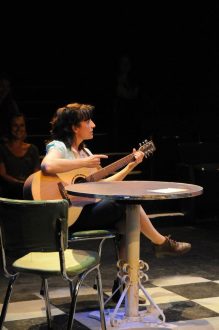
DC: When I did Fiddler on the Roof in Chemainus in 2011, we did the same thing, and it really served to make the village look like a community and pulled us all together in the sense of sharing our music. I certainly think the same thing happens here, and it also solves some spatial problems, as we wouldn’t have room for 5 extra musicians. Financially, it also makes sense, as we just can’t afford to pay that many more people. One of our musicians is also our sound designer, so we are all really multi-tasking. I think this makes our performances unique, as the audience can share the music with us in that special way. It’s also a great challenge to tackle memorizing the music!
 4) The play has major themes of redemption and new beginnings — how do these themes resonate with you?
JM: Percy’s journey is so unique, in terms of a female lead character in the musical theatre canon. The challenges she must overcome, and the way in which she begins to do so . . . it’s all portrayed in a very idiosyncratic (and well-crafted) way . . . The self-love she is lacking, the way in which she must first forgive herself, before she can move forward, and allow love and light back into her life . . . this theme of self-forgiveness, of unconditional love and compassion for one’s very self . . . I think it’s something we could all use more of; it’s interesting when you begin to realize that you’re tougher on yourself than you are on anyone else in your life.
GR: I think these themes are universal and resonate for all people who have needed second and third chances during their journeys. We are not perfect and so forgiveness is necessary so that we can start anew.
BP: Humans are so complex, but I believe, these are some of the most noble characteristics we, as a race, possess.
DC: I really am impacted by these themes. I’m not afraid to go to an emotional place when I watch a show with this kind of a story. When I get the chance to tell this kind of a story, I absolutely love it. It’s amazing to make an audience laugh, but really fulfilling to make them cry when they see your story. These are universal truths that everyone can relate to.
5) What about the desire to get away from city life and start over in a small mountain town — does that have any appeal for you? Why do so many feel that longing to escape, and yet so few actually follow through?
GR: The story of humanity often involves the search for utopias. Curiosity and the longing summed up in the phrase “the grass is always greener on the other side of the fence” is part of our makeup. The back-to-the-land movement still has its proponents but unless you are well prepared for hard work the search for utopias often end badly.
BP: Well I always want to drive out of the city in the fall, just to see it all change, and we are so blessed in Canada. There’s nothing to see but shocking beauty all the way. As a Baby Boomer, I am seeing it. And I know that smaller towns in southern Ontario are being revived by the influx of retirees and that the municipalities are welcoming them and catering their services to them. Wonderful.
DC: I love the idea of getting away . . . I’ve actually done it many times through my acting and my photography, so that appeal will always hold for me. There’s also something very attractive about knowing everyone in your community. Most people are bound by their circumstances, so they can’t get away for long. Sometimes not at all. I’m actually quite satisfied with getting away for short stretches, and I do admit living in a big city has its advantages too!
 6) Gilead means “hill of testimony” or “mound of witness” — what significance does that have for the story? For you?
GR: Change is inevitable. How we deal with it defines us as people and Christians. This story is one of people struggling to deal with challenges to their faith, their beliefs, and their behaviour. The audience is given the opportunity to “witness” their struggles and view their victories and defeats as the characters come through the crucible of hard economic times and social upheaval.
BP: I lived on a ranch in Southern Alberta as a child. We would head down for picnics, in the fall, to the Old Man River and the cotton wood trees give off this amazing aroma: lovely, fresh, green, sweet. Years later I learned that that smell is called the Balm of Gilead. It is one of my favourites and takes me right back to being 5.
DC: We did discuss the meaning and significance during rehearsals. It’s quite symbolic, and was carefully chosen by the writers. I think the hymn I play in act 2 says it all: there is a balm in Gilead. It’s necessary to go to a specific place to make the wounded whole again. And Gilead is that place. And when you commune with God’s creation (ie, nature), you are brought closer to God, and his healing balm. That doesn’t happen in the big city.
7) Why is this story relevant to Vancouver audiences today?
GR: Vancouver is a city in flux and we are in economic hard times, causing stresses on the long held beliefs of its residents. “Gilead, Wisconsin” is a microcosm of what is going on worldwide. How a fictional little town in the mid-west U.S. deals with its problems is incredibly important to larger centres.
BP: Theatre keeps us human. It lets us sit in the dark as it illustrates horrible events and misunderstandings and misplacement of feelings and then climb out of the holes we dig for ourselves and not only survive, but ultimately, recover.
DC: Vancouver audiences will be seeing this play for the first time, and I am very interested in their reactions to it. If their response is anything like mine, they will receive it with open arms. I think the appeal is twofold: the music, which is such a powerful force in people’s emotional states, and the setting, which will hopefully have the same appeal to us big city folk: get away and simplify our complicated lives; let go and let God also applies . . . we are all yearning spiritually for something.
8) Of all the jobs you’re doing in this production (acting, directing, musical directing, playing an instrument, helping create props, taking photos, recruiting sponsors, etc.), what’s you’re favourite?
GR: I must admit treasure hunting for props was fun. Playing the music and witnessing the coming together of such widely varied, yet brilliant, talents is inspiring.
BP: I have really enjoyed making props. It takes me back to helping my kids do crafts when they were wee.
DC: I’m doing everything so that I can perform. I love to act and sing, so all the other tasks are necessary to make this happen. It’s a labor of love for sure…
9) Has anything surprised you working on the show?
DC: I guess there are a lot of small surprises. I am very impressed with what our set, costume, and prop designer, Francesca Albertazzi, has done. Our light designers, Ian Schimpf and Ian Giles, have also done great work. I think perhaps the way the whole collective has rallied to help out in many areas has been a pleasant surprise. Kerry van der Griend has done a fantastic job of shaping a very difficult show in a tricky space, so his deft handling of that has been a nice surprise (although I had a ton of confidence in him already). The biggest surprise of all would be lots of sold-out houses!