
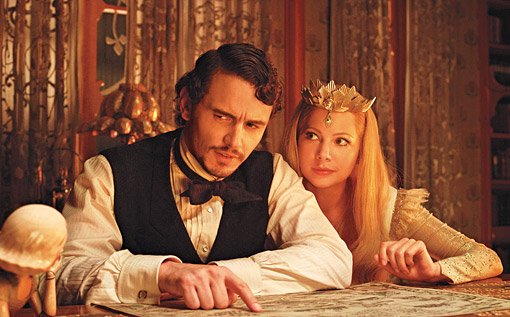
James Franco stars as Oscar Diggs (Oz) in Disney’s new movie Oz the Great and Powerful. The film represents a prequel to the original Warner Brothers film The Wizard of Oz (1939) starring Judy Garland. I was privileged to view the film with a member of the visual effects team, and without being too biased, I must say the sets, visual effects and cinematography of the film were spectacular, imaginative, and delightful. The china doll character, in particular, is exceedingly lovely and well done. Any fan of the Warner Brothers film will appreciate numerous homages and references to both its images and story and any fan of Disney will appreciate the characteristically Disney happy ending.
The acting, however, is somewhat mixed. James Franco and Michelle Williams provide pleasant on-screen chemistry, but Mila Kunis, playing the role of Theodora, begins well but struggles to breathe life into the flatness and unidimensional reality of her iconic character. Despite the movie’s attempt to create rounded characters and a fuller sense of motivation for good and evil, it remains stuck in a stock set of binary polarities which develop minimally or not at all. Oscar Diggs is the one exception, whose story we follow from sleazy carnival magician to Oz the Great and Powerful.
The plot is built on a simplistic ideology that emphasizes faith and the power of belief over truth. Thus, when the victory in the battle for Oz is achieved through a successful manipulation of belief, salvation as a result is tenuously wrought on a necessary lie. Oscar, who plays a sort of messianic character, fakes his own death in order to rise again as the great and powerful Oz. However, Oz, with all the attributes of divinity, is literally a projection of humanity for the sake of humanity. Which is why I see Oz as a veiled critique of religion and Christianity from a modern secular perspective.

Similar themes can be seen in the Christopher Nolan’s recent Batman trilogy in which technology is celebrated and Harvey Dent’s iconic status as the “white knight” is preserved by Batman and Officer Gordon for the sake of Gotham and Batman also fakes his own death. Film critic and philosopher Slajov Zizek has spoken about the ideological level in which Batman suggests that order in society rests on a necessary lie. Zizek has also spoken illuminatingly regarding Kung-fu Panda’s ideology of the power of belief and the popular opinion that denies any real truth while simultaneously affirming the psychologically functional value of faith. Thus, the contemporary understanding of functional faith, the reliance on technology, and the necessary lie are the prominent ideas underlying the narrative of Oz.
Furthermore, unlike the original, there is no return to Kansas. Oscar escapes his reality into a fantasy in which all his dreams come true. This is, to some degree, necessitated by the movie’s status as a prequel, however, rather than questioning or undermining it, the movie rather uncritically celebrates it.
Ultimately, while the film is visually lush and provides the typically enjoyable emotional rewards of a Disney movie, it does so on a rather suspect ideological foundation and merely decent performances from the cast. For fans of the original film this is certainly a must-see, but for all others, it is eye candy with fairly standard secular ideology that severely undermines religion as, at most, smoke and mirrors for the sake of good.
Credit: Merie Weismiller Wallace