
As you stretch out on your favourite armchair, your slippered feet reach toward the crackling fire. You’ve got one of your thickest sweaters on, and your hands keep warm by clasping your gigantic mug of tea. You breathe in its steam and all the day’s angst seems to disappear.
It’s a scene that’s played out in living rooms daily. But it couldn’t be more different from the place where tea actually comes from: tea is grown on highland farms in the tropics of Africa.
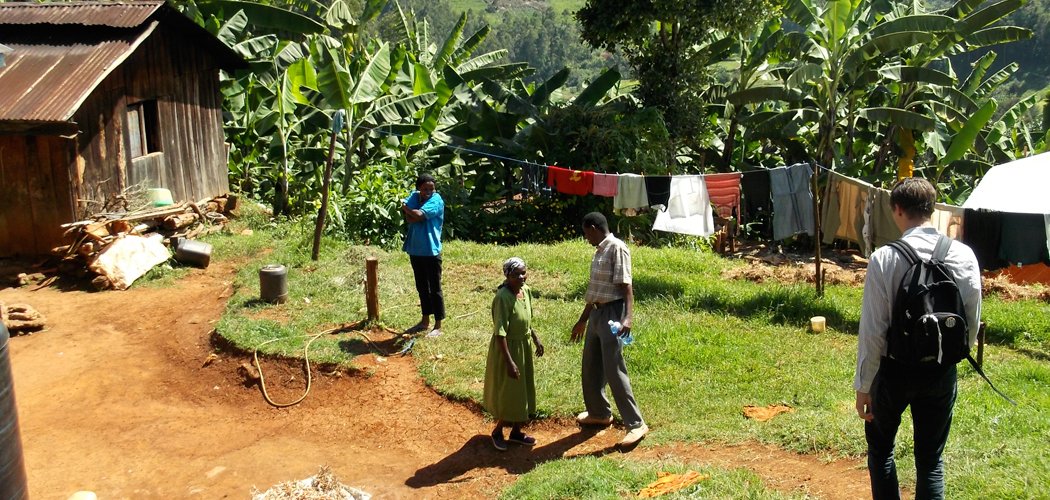
I have had the privilege of seeing the whole process firsthand. Last winter I met some tea farmers who had wanted me to meet some of their relatives in the backcountry of Kenya.
The journey was arduous — through winding roads, swerving around the axle-breaking potholes, surrounded by jade-hued tea bushes.
Our friend and driver took us to his Grandma’s house, a sun dried three-room mud hut. I ducked to enter the dark, windowless room. The sofas were colourfully decorated with lace and red cloth, and the walls were arranged with over 30 family photos. On the main wall, there was a large pastoral print of a grassy knoll, and a stream surrounding an English country farmhouse and a water wheel.
Grandma sat in a darkened corner; she’s very old, I guessed. Underneath the wrinkles, her large hands are those of a tea plucker, calloused and strong. Slowly rising to greet us, she examined the three white faces staring back at her. She spoke only the tribal language, so we offered a quick greeting and settled into the wonderful Kenyan hospitality: a thermos of Kenyan tea and kigieri, which is a mixture of roasted nuts and corn.
Through her daughter’s translation, she told us we were the first muzungus — whites — she has seen since the British left in the 1960s. Grandma said she holds no resentment to us for what they did to her family.That she didn’t blame us for their “divide and rule” campaign, which stirred up old inter-tribal wounds. We could only imagine the stories she kept hidden behind her sun-creased face.
As we walked down the steep path from the mud home, chickens scattered and dogs barked ferociously. Children scampered around the steep trail.
I noticed the locks on most of the doors in the village; I later learned they symbolize a father who has died of AIDS. I looked around at the women who are left to survive off the meager tea earnings. What is wrong with the world’s largest black tea market — Kenya? Why do these women suffer from a lack of food, education and health choices?
As a result of this journey, JusTea was formed. It’s a different kind of tea company. JusTea’s simple idea is to bring tea processing knowledge down to the small scale farmer. Tea processing co-ops allow farmers to sell tea directly to the export customer. By cutting out the middle man, these men and women tea farmers are able to not only survive, but afford things like school uniforms for their children.
It’s not so simple to find out where things are from, but when you do, don’t back away from making a change in your consuming habits. When you buy black, chai or earl grey tea from JusTea, it not only brings comfort to you on winter days, it provides people like Grandma and her family with the simple basics of life.
If you would like more information about JusTea, please visit www.justea.com.