
“I think we need to decide as people who we are. Before you walk out the door in the morning you need to decide who you are. What your values are, what makes up your own unique DNA. But within that, where’s your framework? What’s important to you, what do you want your life to look like, where do you want to be in 10, 20, and 30 years from now? I think in the morning when you wake up you need to think about that. Because it sets the tone as to who you are and it makes you authentic as a person.” — John Fluevog
From John Fluevog you can expect to find women’s boots that look “safe” from the front, but from the side reveal hourglass-shaped heels. Shoes from his men’s collection are equally unique and feature ultra pointy toe tips and super scrunchy creases where the foot would naturally lift. The names of the shoes also stand out, like Edwardian Hamburger or Queen Transcendent. Although Fluevog is a trendsetter, his eccentric style is not for those who religiously follow mainstream fashion trends.
The world may never have known Fluevog’s designs if he hadn’t taken a job at a Vancouver shoe store called Sheppard’s back in the ’70s. It was there that he met Peter Fox, his first business partner. The two joined to create the popular footwear outlet Fox & Fluevog. In 1980 when Fox went to New York, Fluevog decided to create his own brand. Since then it has taken off with celebrity fans from Alice Cooper to Madonna.
His flagship store in Vancouver’s Gastown is situated in the negative space between two old buildings. Inside it’s spacious and almost studio-like with a cement floor, brick walls, and a glass ceiling. Light pours in, even on this grey day.
The bottom level hosts the showroom where shoes are placed on low tables made from old growth oak trees. There is ample room for wandering between aisles, a large L-shaped couch in the corner, and wooden benches for customers to use.
A staircase leads up to a loft where Fluevog’s design team works. Upstairs are rows of desks, each with their own walls for pinning ideas and inspirational material. A huge selection of men’s and women’s shoes line one wall — some conceptual designs, others awaiting their debut in future collections.
The workspace has a relaxed vibe with employees dressed in smart casual attire. There are also some very well behaved dogs who seem to enjoy snoozi

ng under desks, occasionally taking a romp into the showroom to greet patrons. I meet a shy black lab mix named Maggie and a tan French bulldog named Peanut. It looks like an appealing place to work.
Leading the band
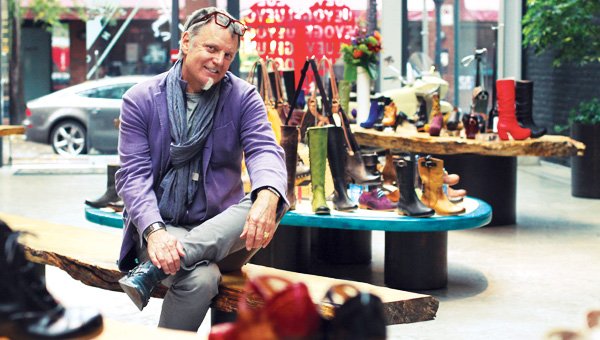
Fluevog is wearing a purple blazer, a grey shirt, grey pants, and dark green shoes. Glasses are propped on his head.
He begins our conversation by saying that lately he’s been thinking a lot about jazz and the ways in which his company operates like a jazz band.
On a recent trip to Quebec City, Fluevog got the chance to take in some jazz and after the show was able to chat with one of the musicians.
“I said, ‘Hey, it’s really cool how you guys interact together, how you play off each other.” Fluevog says he was quickly corrected. “A lot of people think it’s a democracy . . . it’s not. Somebody always sets the tone and the mood,” the musician replied.
The shoe tycoon thought it was a great analogy for his design team. “I need them but I need to take leadership, and I need them to play in my band. We can’t be so out of sync. We’ve got to be playing the right music together,” he tells me.
Fluevog, who was raised in an evangelical home and still maintains his belief in God applies the jazz analogy to his own life. “We’re in a band and we need to know what the tone of it is, we need to buy into it . . . I think that the idea of us working together as a group, as a body as it were, is just such an awesome concept and so powerful.”
Authenticity
I can tell that Fluevog is a bit hesitant to talk about his faith. Perhaps it’s the way he enunciates the “n” in the word Christian. I can only assume it’s because he doesn’t necessarily want to be branded with the “Christian” label, not because he doesn’t have strong beliefs, but because once you are open with the C-word, people tend to put you in a box.
To his credit, he does a good job of infusing his beliefs into many aspects of his company culture. His entire website is brimming with biblical references. Even Fluevog’s products proudly proclaim his faith. He has shoes called Angels that offer the tagline, “Satan resistant” and men’s belts with the familiar scripture from Ephesians, “Stand firm with the belt of truth” inscribed on the reverse.
I have no doubt that it is this devotion to authenticity, to being exactly who he is without wavering, that has gained him such a loyal following.
Everything he does is distinctly Fluevog. He does what he wants even if that means creating shoes that many simply brush off as weird. It’s because of his offbeat style (creating designs that few if any designers would dare undertake) that he has attracted a following of fashion misfits.
Customers rave about his shoes. “John Fluevog is like my Santa,” wrote one commenter on a popular user review and recommendation website. “As a self-proclaimed quirky girl, there are few shoes that rock the off-beat harder than a pair of vintage-inspired Fluevogs,” wrote another.
It seems almost laughable now, but in his earlier days Fluevog wasn’t aware that he had original ideas. “It didn’t occur to me,” he says. “But I have found that being more of myself has been a good thing, a better thing. And I think being more of yourself is actually an act of faith because you’re believing that what God has made is very unique and beautiful so therefore you’re allowed to be more of yourself.”
Because of his distinct style, Fluevog doesn’t always get the mainstream press that other brands do, but he tries not to let this bother him. “I cannot judge my worthiness or my identity by that. I need to do what I feel I need to do. I need to do the right thing for me. And fortunately I have enough people that like my stuff that it keeps it up and going. I actually don’t need the press,” he acknowledges.
I tell Fluevog that I recall seeing his shoes in my boyfriend’s GQ magazine. I think he’s just being a bit modest when he says he doesn’t get much press.
“I do occasionally. But I don’t really go after it. And it’s nice when it happens,” he finally admits.
Fashion as a frivolity
There are many people who view designers as sort of a selfish group of people. Designs, after all, don’t help eradicate hunger, aid the homeless, or cure any diseases. Fluevog does, however, think that they have a major responsibility; and that is to be honest.
“What designers do is they pick up on feelings and emotions that are swirling around. There’s this concept that ideas float around out there. I don’t know how else to put it. And you need to be available to be able to hear them,” Fluevog explains. “If you’re too full of your own ideas and your own thoughts and all about yourself, you’re not going to be available to hear.”
He goes on to say that good design should be able to “change our perception” but that it should also resonate with people. If nobody likes it, nobody will buy it.
On originality
It’s hard to come up with an original idea these days; it seems that everything has been done. I for one will fully confess to desperately imitating the writing styles of those I admire. How does Fluevog come up with such original ideas?
He says he doesn’t.
“It’s the order in which we put things together that makes them original. It’s not so much that I made and thought of that idea from scratch. I adapted,” he explains.
He then walks over to his wall of shoes and fetches a black patent pump with a clawfoot heel and a Mary Jane strap. He calls this shoe Queen Transcendent. I immediately understand what he’s talking about. I’ve seen the clawfoot shape on old bath tubs and the Mary Jane is probably one of the most iconic of children’s footwear styles, but I had never seen the two used together until now.
“The shape of that heel is nothing new,” he says. “I didn’t design that shape, but I put it on a shoe.”
The future
I’ve always wondered how people who have already achieved so much stay so motivated. When goals are achieved, what’s left? Fluevog says he doesn’t have goals per se, but he does have a picture of what he’d like his life to look like.
I ask him if he can describe what this picture looks like to him.
“Not easily,” he says, “It’s something to do with transcending. It’s something to do with coming to a place where I’m not quite connected. Where I’m less and less worried about what we call earthly things. Because I’m going to die in not too long and I love the idea of being able to connect to creation and the creator.”
Advice for the aspiring
As our conversation comes to an end, I’m struggling to unearth the key factor to his success. Is it his originality? His authenticity? His faith? It turns out, it’s a bit of all three.
Fluevog’s life advice is simple: know what you want out of life. He brings it all back to the jazz analogy. “If you want to play in a band you’d better come and join the band. If you don’t want to be in a band that’s okay. You can go off and have a solo career.”
He says to look at the bigger picture.
“Your goals should be things like, ‘I want to work in a team, I want a family, I want good relationships, I want to end up at 50 years old, having said I helped some people, that I was part of a process, that I’ve done something creative in a team,’” he advises.
According to Fluevog, never before has individuality been so valued in the workforce.
“The biggest thing I would say to somebody starting out is you need to be yourself. It’s very difficult if you’re not that. If you’re just going to do something the same way somebody else has been doing it, that’s tough. You need to take whatever it is and put a flavour of your humanity into it, the good and the bad. You know, the good, bad, and the ugly. Make it [and] put your stamp or your thumb print into it.”
Well, that’s how John Fluevog did it anyway.