
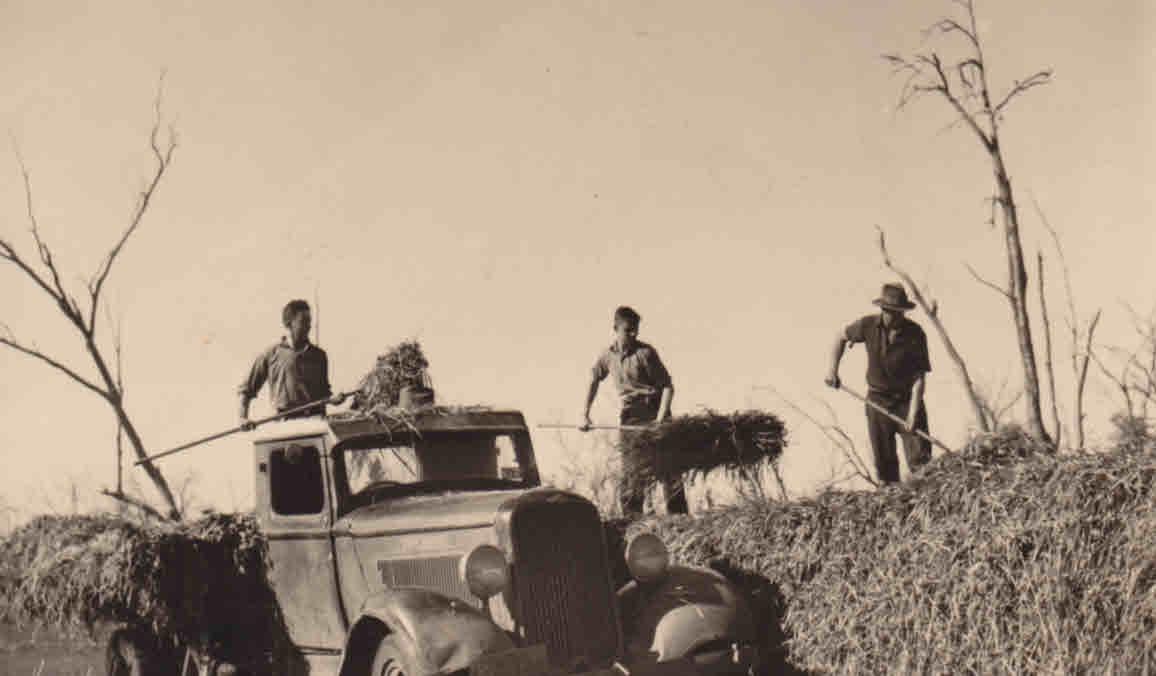
Everyone knew who they were. Wandering the halls in steel-toe boots, jeans, and plaid, they talked tractors and nodded from under hats bearing the logos of local feed suppliers.
They skipped school — not to bum around the mall or smoke up down the street — but to help with harvest. In the complex hierarchy of high-school subcultures, the farm kids occupied a category of their own, and everyone knew who they were.
I recently had a conversation with a friend who had returned from a season of work on an organic farm. Among other things, she also works as a barista at a downtown café and regularly helps organize fashion shows. The lines dividing my high-school system of social classes have now been blurred, and the people now interested in raising laying hens and planting fruit trees are looking a lot different than they once did.
Even if you live in the heart of downtown Montreal, chances are that you or someone you know has either expressed interest or participated in some sort of farming experiment. WOOFing (Working On Organic Farms), community gardens, farmers’ markets, and summers spent on local farms are no longer reserved for middle-aged men in straw hats; they are now the stuff of hipsters and socially-conscious undergrads looking for summer employment. The do-it-yourself appeal of producing one’s own food, along with participation in an alternative to what many view as destructive and unsustainable food production have a surprising number of young people interested in farming.
Whenever I mention I often spend several of my summer weekends canning fruits and vegetables with my family, I receive a litany of envious responses. What folks want, I think, when they respond like they do, is the deep satisfaction and sense of reward and independence one experiences having produced one’s own food — a satisfaction that cannot be found in the aisles of your nearest grocery store.
At some level, we all know that something is profoundly w rong with our food system, and it doesn’t take an environmental engineer to explain it to us. Nearly all the edible material you and I handle nowadays is some far-removed bi-product of the earth. Think about the last meal you ate. How many stages of processing, packaging, delivery, and sales did it have to go through to get to your plate? How many separate ingredients were shipped? How many separate kilometers prior to that? With all of that in mind, we can begin to understand why there is something powerful about the immediacy you experience when you brush the dirt off a carrot you planted months ago and just now unearthed, and why a disillusioned, dot-com city-dweller would be interested in doing just that.
Before you abandon your degree and run off to the countryside though, you need to know that it is incredibly difficult to make a living farming at a sustainable, small-scale level. Agriculture nowadays is a big-business affair, and in many ways a complex and broken system whose problems simply will not be solved by planting an urban garden or making a trip to the local organic market. There is, however, something that can be learned from all of this, and something profound that can be reclaimed in our efforts, however small, to participate in the work of agriculture.
We were created for connection with the earth, and, in our increasingly disconnected urban landscapes, our generation has begun to long for a return to that vision of living. Community and rooftop gardens, farmers’ markets, and summer internships are really tangible ways to become more environmentally and socially conscious. In a very real sense, participation in the work of the field hand is a way of becoming human.
This is the last of our faith and farming series.
To read part 1: How farming and faith relate
Part 2: Theology of food
Part 3: Graveyard for silos
Illustration by Jennifer Ku
Flick photo (cc) by john cowper