
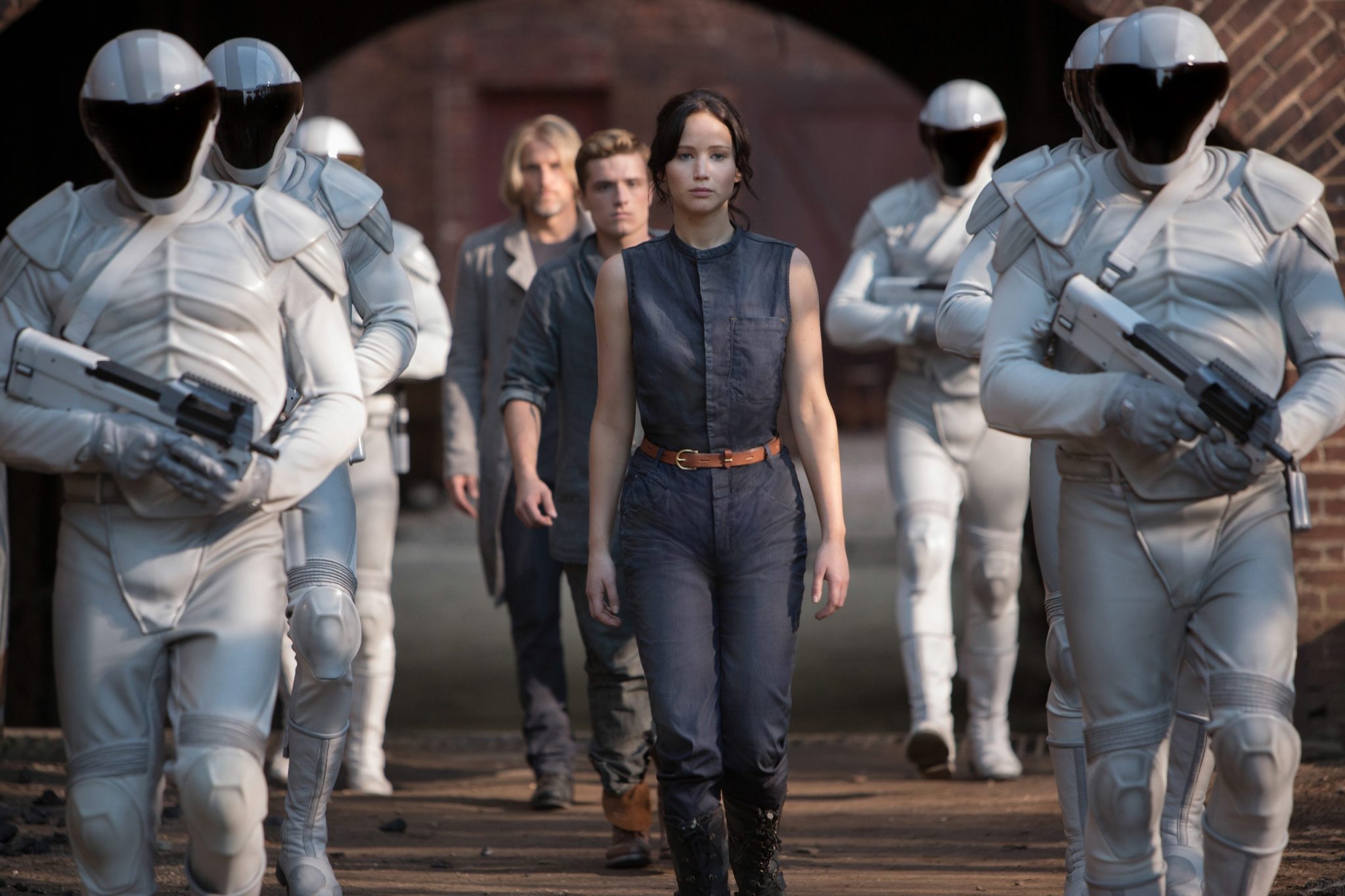
The first thing you notice watching Catching Fire is the change of colour. Gone are the lush greens of the forest. Now our eyes are filled with greys and browns: the muted colours of the dead of winter.
We meet our hero, the steely Katniss Everdeen, in the woods, but she is anything but victorious following her victory in the Hunger Games. She lives in an empty “Victor’s Village” plagued by nightmares of the killing field. To find reprieve, she spends much of her time retreating to the woods, but her fears follow her even into this solitude — the psychological damage of the games is unceasing.
Worse, she is forced onto a “Victory Tour,” visiting the districts to commemorate the games. With all eyes watching her, including a threatening President Snow, Katniss must play the part of smitten lover to Peeta Mellark, a choice which is complicated by her growing connection to Gale Hawthorne back at home.
Katniss’ fake love for Peeta is complicated as well as she begins to develop real feelings for her fellow victor — who is able to understand her nightmares in a way that Gale may never be able to. But unlike some other series’ in the same genre, we aren’t given much time to dwell on the romantic drama of this triangle, as we are pushed into a larger story of a brewing rebellion.
Catching Fire, the middle book of Suzanne Collins’ trilogy, changes the narrative of The Hunger Games from being one girl’s story of survival to that of a global movement. The second installment is often the hardest part of any series, and most sequels that do well look to Empire Strikes Back for inspiration.
Catching Fire has a few nods to that movie, with a darker tone and a bit of a twist ending. The Capital’s soldiers even look like spiney bug versions of stormtroopers. But it never reaches the emotional height of Empire, distracted as it is by the puzzle box of the Quarter Quell in the second half.
The Hunger Games in one sense reads as a critique of reality television. Prompted by the ever-charming Caesar Flickerman (a once again spot-on Stanley Tucci) the fans in the Capital are presented with the happy vision of these lovers. We get a look behind the scenes of this reality TV set to see the facade for what it is: a barren, muddy-brown street.
When the time comes for the victors to enter the arena once more, the games become a distraction from the overarching plot. In the book, we are given the advantage of reading Katniss’ thoughts as she tries to deduce what is happening, and who she can trust. In the movie version, we aren’t party to these head games. Given this, the first half of the film is much more interesting, punctuated by great performances from Elizabeth Banks (as the ever oblivious Effie Trinket), Philip Seymour Hoffman (as the new gamemaker Plutarch Heavensbee) and of course Jennifer Lawrence.
We’re presented with a choice within the film: will we allow ourselves to be distracted by things like a celebrity wedding (would anyone be guilty of that?) or are we concerned with the inequality and injustice present in our world? Do we soak in the killings presented to us, snacking on our popcorn and candy while hollering for more, like vicious fans in an ancient (or future) Coliseum? It’s entertainment that can only be enjoyed if you “abandon your moral judgment,” as Plutarch says. So it is with The Hunger Games.
The question is: does Catching Fire awaken us to look the world with open eyes? Or do we forget it, and like the closing credits of the film, cue the Coldplay music?