My first reaction to learning that a Boston bombing movie was in the works was that it was too soon.
It reeked of opportunism. It felt like a deliberate attempt to be the first to cash in on an event that captured the imaginations of most North Americans for the better part of a month, and judging by the reaction to the most recent Rolling Stone cover story on Dzhokhar Tsarnaev, the said suspect, it is a story that continues to capture our imaginations.
There were many times in the aftermath of the Boston marathon bombing when the story seemed to defy reality. The marathon runners kept running, but it was in the opposite direction. Social media exploded with accounts of the bombing, but many used it as an opportunity to participate in a sort of vigilante social media manhunt. The suspects shot and killed an MIT police officer before carjacking a Mercedes SUV, all of which helped police to identify them. The suspects had an “unprecedented” shoot out with the police in a locked down Boston neighbourhood where one of the suspects was killed after he was shot and then run over by the other suspect in the stolen SUV as he miraculously escaped. The remaining suspect was eventually found hiding under the tarp of a backyard boat, and his capture sparked many large street celebrations all across the city of Boston.
If truth is indeed stranger than fiction, this is a pretty good case in point, and it should not be surprising that a movie about the Boston bombing is now in the works.
Despite my better judgment, I feel I should suspend my criticisms about a not-yet-confirmed film about the Boston bombing.
One reason for my hesitation is that movies are much more than just a money-making venture. Movies are an art form, and like any art form they are multi-layered. Meaning can go far deeper than the surface. The aforementioned Rolling Stone cover story is a good example of this. If you did not know any better you would think Dzhokhar Tsarnaev was an indie rockstar in the vein of Bob Dylan, but the headline gives a more layered story: “The Bomber: How a Popular, Promising Student Was Failed by His Family, Fell Into Radical Islam and Became a Monster.”

There has been much fuss over the cover – it has been called “tasteless,” “trashy,” and “exploitative” – because it has the potential to mislead people and give them the wrong impression. The cover of Rolling Stone is usually reserved for celebrities so to put someone on the cover who is a celebrity because of their infamy is disconcerting for many. The disconcertion is valid, of course, because the Rolling Stone cover may do more harm than good, but to criticize it outright is to miss the deeper point that the cover and the story are trying to make: we are complicated people with complicated problems. We are not as different to Dzhokhar Tsarnaev as we would like to think. We are both saint and sinner, friend and foe, hero and villain, capable of both great goodness and great wickedness. I do not see the story or the cover as a glorification of evil, as some have said, I see it as an honest investigation into the multi-faceted human condition.
My point here, however, is not to admonish or support Rolling Stone for trying to tell stories and sell magazines, my point is to argue that a purely surface level understanding of art will almost certainly distort the deeper purposes of that art.
This is why I fear for a Boston marathon movie. I fear that the movie may remain surface level and distort some of the dirty, messy, and essentially human elements of this tragedy. I think we are just too close to the bombing for filmmakers to faithfully create or for fans to fairly judge whether the movie successfully depicted the events and the people involved. History is the arbiter of wisdom and wisdom the arbiter of fairness. Hollywood seems to have very little wisdom as it is, and I fear that even less historical perspective will only perpetuate the problem. But, this might be of little consequence anyways because the majority of moviegoers may not even care whether the movie was faithful or fair. I mean, if we are entertained, what does it matter?
I could be wrong, though. I thought the Social Network and Zero Dark Thirty were made much too soon but they proved to be very good movies, which is another reason why I choose to withhold my criticism.
If I had a chance to speak with the filmmakers or scriptwriters currently working on the project I would ask them a simple question: why make this movie now? A movie never has to be made. So why now and not later?
My hope is that the filmmakers can honestly answer this question with something other than money or American nationalism. If so, then I eagerly await a movie about the Boston marathon bombing (it needs to be said that Boston is the best setting for Hollywood movies bar none). If not, then yes, I will be ready to be critical again, but even more than that I will lament the loss of tragedy, because tragedies should be moments for reflection, not opportunities for profit or propaganda.
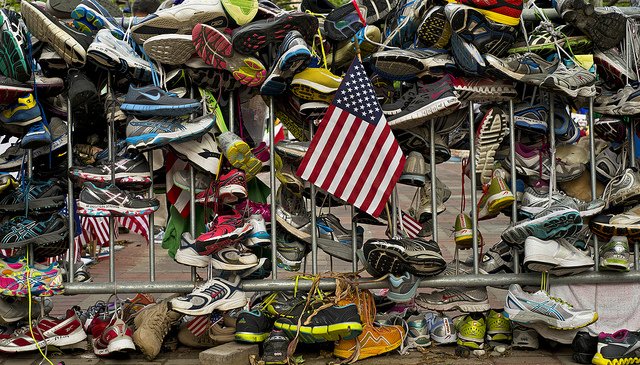
Flickr photo (cc) by AirmanMagazine