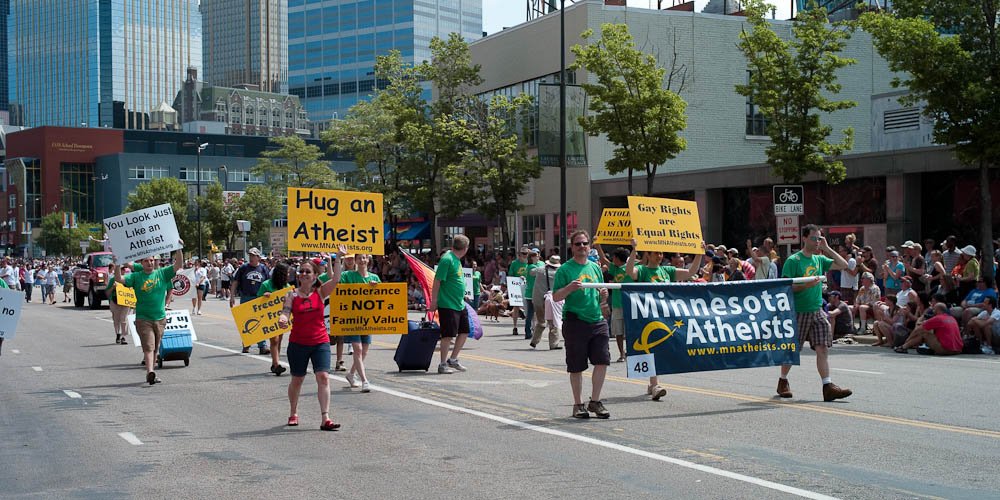
Atheists are a hard group to pin down.
They are defined not by what they believe, but by what they don’t believe — namely, God. Because of this, atheism is by definition a negative belief, not a positive one.
Holding a negative belief can at times be problematic. It would be like if somebody asked you where you lived and you listed all the places where you don’t live. It’s not wrong, but it’s not very constructive either.
Even Sam Harris, a renowned atheist, captures some of the contradictions inherent in the word “atheism.” In his book Letter to a Christian Nation, he says,
“In fact, ‘atheism’ is a term that should not even exist. No one ever needs to identify himself as a ‘non-astrologer’ or a ‘non-alchemist.’ We do not have words for people who doubt that Elvis is still alive or that aliens have traversed the galaxy only to molest ranchers and their cattle. Atheism is nothing more than the noises reasonable people make in the presence of unjustified religious beliefs.”
This is why many atheists prefer to identify themselves in more positive terms like materialist, naturalist, rationalist, freethinker, humanist, or secularist rather than negative terms like atheist or agnostic that are unavoidably linked to religion.
A 2012 Pew Forum study used the term “nones” to identify individuals who did not express any religious affiliation. Interestingly though, despite what “nones” seems to imply, it does not actually preclude a belief in God: “Most of the ‘nones’ [polled in the study] say they believe in God, and most describe themselves as religious, spiritual or both.”
This goes to show that no one is actually a “nones” in every day life. Everyone holds positive beliefs, values, and practices that govern their choices on a daily basis.
Even atheists.
For this reason, some people argue that atheism should be considered an ethnicity.
In the National Post, Jackson Doughart recently argued that a person raised in a secular household would assuredly absorb many of the beliefs, values, and practices of their atheist parents. According to Doughart, ethnicity depends primarily on the group into which an individual is born. And as it appears in Canada, atheism is increasingly becoming a cultural “group.”
It might seem odd to consider atheism an ethnicity, but when you look at the definition of ethnicity it’s not completely illogical. Ethnicity, at its core, is a set of values and practices passed down from generation to generation.
Ethnicity is not unlike culture, which is also concerned with values and practices, but it is also not the same as culture. Where ethnicity is backward looking and concerned with tradition, culture is forward looking and concerned with future.
In other words, ethnicity is culture’s tradition.
So, if we accept that atheists or secularists or humanists are a group who hold positive beliefs that are part of a cultural tradition, then it isn’t a stretch to think of atheism as an ethnicity.
We also tend to define ethnicity along racial lines, but this doesn’t have to be the case.
Consider Judaism, whose “ethnicity” now contains numerous different races, or the Balkan states of Croatia, Bosnia, and Serbia who are racially similar but ethnically diverse because of their religious traditions.
Or think of Canada. Canada consists of an eclectic mix of races and cultures that make it very difficult to point at someone or some community and say, “You are Canadian!” (Not that Canadians would point — that would be rude.)
But just because it’s difficult to articulate what it means to be Canadian doesn’t mean there is nothing that is distinctly Canadian. Canada has a cultural tradition and that tradition could — and perhaps should — be thought of in ethnic terms.
The same is true for atheism. Just because it is difficult to articulate what an atheist believes, doesn’t mean they don’t believe anything.
We all, whether we like it or not, inherit beliefs from those who came before us.
It’s likely that atheists will surely scoff at any attempt to categorize their community based on inheritance. Atheism does, after all, come from a pedigree that attacks any inherited belief or tradition. No belief or tradition, religious or otherwise, is safe from the probes and scalpels of the iconoclastic atheist who believes that the laboratory is the only place to discover truth.
But herein lies one of the major problems with atheism: it assumes beliefs should not involve any dimension of uncertainty. Which is unlike religious belief, that faith is built on trust, not proof.
Most of our inherited beliefs, values, and practices cannot be proven as fact. No matter how hard the atheist or secularist or humanist may try, they will not be able to reject everything that can’t be measured or constructed with the scientific method. Some things, like ethnicity and cultural traditions, are beyond the reach of science. And ironically, this means that atheism is also beyond the reach of science, because many — I dare say most — of its inherited beliefs, values, and practices cannot be proven as fact.
It’s like being Canadian, really. “Canadianness” may be difficult to identify, measure, and articulate. But we know it exists. Somewhere. Even if we can’t prove it.
This article was originally published in the January/February 2014 issue of Converge Magazine.
Flickr photo (cc) by Tom Westbrook