
By national law, each and every coin in Canada is inscribed with the cryptic cipher, “D.G. Regina.”
Fully expanded, the phrase is Dei Gratia Regina, or, to translate from the original Latin, “By God’s Grace, the Queen.” It’s a centuries-old expression of monarchical justification that the state spouts to this day; the royals rule because God wills it.
Anti-democratic though such sentiment may be, affirmations like this remind us that the British Crown is one of the few lingering institutions of modern society that still pays some homage to the idea that authority must have a spiritual component in order to be publicly justified. Not just spiritual, in fact, but explicitly Christian. When Prince William eventually ascends to the throne, he and his wife will be splashed with consecrated oils and take Holy Communion before being proclaimed king and queen. Their crowns will be placed not by any political representative, but by the nation’s leading protestant bishop, and the setting will not a palace or parliament, but the Abby of Westminster.
But are such rituals still genuine? The affinity that was once felt for the royals on a spiritual level (the Queen remains nominal “Supreme Governor” of the world’s 85 million Anglicans) has clearly long since been displaced by the more crass allure of celebrity, leaving the Christian trappings of the Crown somewhat whimsical anachronisms that are often ignored, if not outright undermined. The highly publicized stories of royal infidelity, promiscuity, and overall vulgarity — of which we are all so well-versed — have understandably served to undermine much public faith in the notion that any prince, princess, or duchess deserves to be heralded as a great role-model of moral constancy.
Indeed, it’s hard to imagine any of the future royals engaging in a spiritual summit as dramatic as the 1980 meeting between Queen Elizabeth and John Paul II, where Her Majesty expressed encouragement for a “growing movement of unity between the Christian Churches throughout the world.” Prince Charles, for his part, is said to find the whole notion of Christian exclusivity so troubling to his universalist sensibilities that he’s planning to ditch the customary “Defender of the Faith” suffix of his coming kingly title in favor of a more blandly non-denominational “Defender ofFaiths.”
Yet perhaps this is appropriate. In a nation like Britain (or Canada for that matter) that is increasingly multicultural and multi-faith, the entire business of choosing the nation’s head of state according to the “divine right” doctrine of a single, particular, and increasingly unpopular church can seem needlessly divisive, if not unconstitutionally discriminatory. If the Crown is to continue to provide unity — and enjoy its ample funding, care of the taxpayer — then it certainly behooves the institution to be the royal family of all its subjects, not merely those who join them in the pew on Sunday.
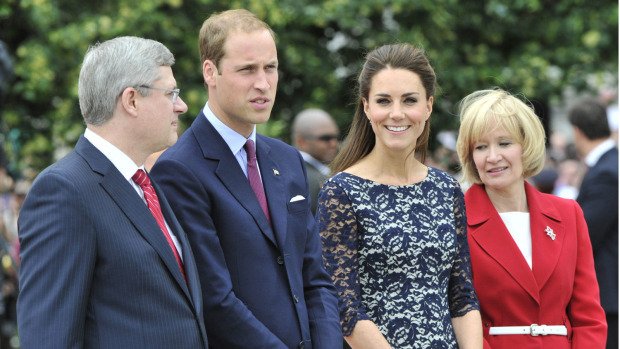
At the same time one, cannot help but feel that the institution of the monarchy has become something lesser by abandoning its Christian roots. Catherine’s dresses and William’s smile are certainly lovely to photograph and talk about, but if that’s all the royals have to offer, then it’s hard to see why they’re worth keeping around. The crass materialism and tabloid tackiness of modern society used to be something royalty could transcend. These days, it seems to be all they have left.
J.J. McCullough is an editorial cartoonist, illustrator, columnist, and pundit. He’s pretty conservative, fairly Canadian and cynical about everything. He has been interviewed on several media outlets including the CBC and Readers Digest. He is a regular contributor to Metro News. Check out his work at filibustercartoons.com or follow him on twitter @JJ_McCullough